






Arviat’s modular homes factory is substantially completed and expected to start manufacturing houses in April.
“We’re really excited. This year on the sealift, we’re already bringing the raw material up to Arviat to start the production,” said Guillaume Guida, Sakku Investments Corp. vice-president of business development.
Modular construction is a process where components for houses are built off-site in a factory, shipped out to where the home will be located and assembled there.
The roughly 64,000-square-foot factory – nearly the area of four hockey rinks – with a 21,500-square-foot warehouse, situated in Nunavut’s third-largest community of roughly 2,900 residents, is expected to produce about 40 homes a year.
The project is led by Sakku Investments Corp., the business arm of the Kivalliq Inuit Association. Construction started in September 2023.
The expected April 2026 startup comes slightly later than originally planned because of construction delays, Guida said.
At this point, the factory’s foundations and most of the walls are up. Now work crews are focusing on connecting mechanical, electric and plumbing systems and building the warehouse, said Caroline Nault, CEO of Sakku Innovative Building Solutions, the factory’s operator.

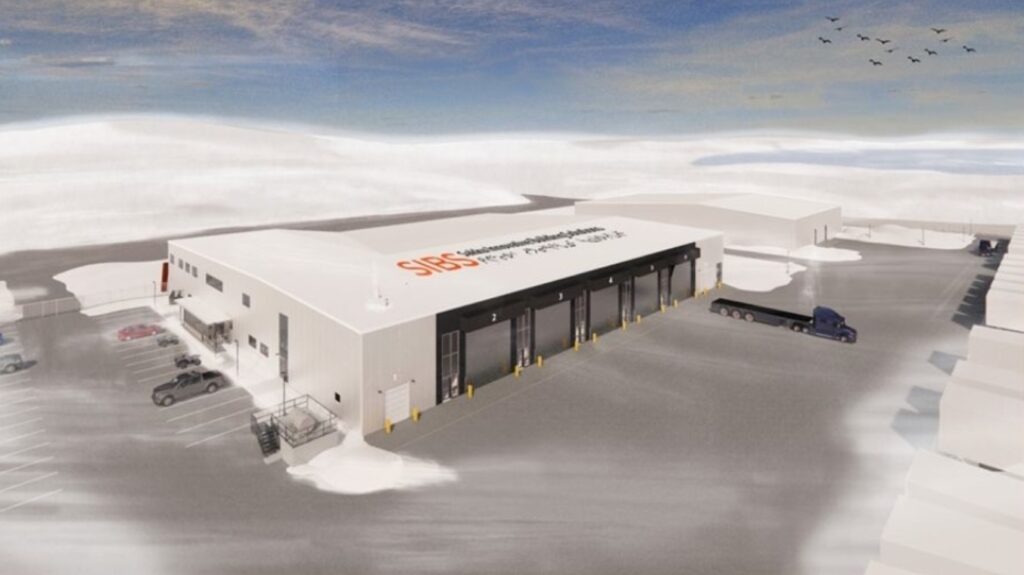
Construction will soon be completed on a modular homes factory in Arviat that is expected to be operational in April 2026. (Photo courtesy of Sakku Investments Corp.)
The project will also go over budget, she said, with an estimated price tag of $70 million instead of the $50 million originally planned.
That change, Nault said, is due to a post-COVID-19 hike in construction costs.
Sakku, the Government of Nunavut and the federal government all pitched in to fund the factory startup.
The idea of creating a modular homes factory in Arviat dates back to 2015 when the Kivalliq Inuit Association, which is mandated to protect the rights of Kivalliq Inuit, directed Sakku to find a way to employ more Inuit in the construction industry, Guida said.
To do that, companies need to provide training, which is difficult in the context of on-site construction where typically “you try to build as fast as you can while the weather is good,” Guida said.

But with modular home building, construction can go on all year round in a factory.
So Sakku decided to give it a go at a time when modulars were “frowned upon,” Guida said.
“It was not like today when modulars are the flavour of the week,” he said.
For a long time, modular housing was unreliable because most of it was fabricated in the south and unable to withstand the Arctic climate, he added.
So, in 2018, Sakku formed a partnership with RG Solution, a Quebec firm that specializes in building modular homes.


Minister John Main, in the middle, is one of the officials touring the nearly-complete modular homes factory in Arviat in June. (Photo Courtesy of Ron Elliott)
The difference with the modulars that will be built in Arviat is that from insulation to roofs and windows, they are built specifically for the Arctic, Guida said.
“It’s not something taken from the south with a cute bow on top, trying to fit Nunavut.”
Nault described a standard module the Arviat factory will produce as a “Lego set” approximately 12 metres long, 4.3 metres wide and 3.7 metres high with electrical wiring, insulation, windows and doors.
Two modules would normally make up a two- or three-bedroom apartment.
A module should take about three weeks to build. After that, it’s wrapped in protective plastic and the “huge marshmallows” will be shipped to one of the Kivalliq communities for installation, which should take roughly two months.
Along with 40 full-time factory employees, the enterprise is estimated to create about another 100 jobs that will support construction, Guida said.
For now, he said, the project is set to only focus on Kivalliq.
“But it’s a model that we believe would work for all of Nunavut,” Guida said.
link
More Stories
US president’s son Eric Trump invests in drone maker with gov’t contracts | Military News
Private Construction Promises Strong Season; Questions Remain for Public Spending
Broadway Plan construction pushing restaurants to the brink