




Data collection
This study utilizes questionnaire surveys, semi-structured in-depth interviews, and career tracking for data collection (Ruslin et al., 2022; Taherdoost, 2022). Questionnaire surveys and in-depth interviews maintain strict control over data collection process to ensure reliability and validity of quality. Career path tracking adopts anonymous methods to safeguard respondent privacy and minimize social expectation effects on data. Questionnaire design undergoes multiple pre-experiments and expert reviews to guarantee question validity, clarity, and pertinence.
Questionnaire content covers students’ technical integration ability, critical thinking, interdisciplinary collaboration ability, problem-solving ability, social background information, access to educational resources, and career paths. The design has undergone multiple pre-experiments and revisions to reduce ambiguity and misunderstanding and improve data accuracy. The representativeness and diversity of the sample are ensured by combining random sampling and stratified sampling. The sample covers students from different social classes, ethnic backgrounds, and educational backgrounds to reduce the interference of social background factors on the research results.
The questionnaire includes “years of using digital tools” (1 = less than 6 months, 5 = more than 3 years) and “technology acceptance” (such as “I think digital tools are easy to use”, 1 = totally disagree, 5 = totally agree). To control the impact of other potential variables on career development, this study collects data on students’ academic performance (measured by GPA, 1–5 points) and internship experience (including number of participations, duration, and company level) in the questionnaire. In the SEM, these variables are included in the analysis as control variables to isolate the independent effect of social background.
Data is collected from six universities in China, including two public comprehensive universities (University A, University B) serving urban and suburban populations from different socioeconomic backgrounds. Three professional art/design colleges (College C, College D, College E) are known for their high penetration of digital tools, but with limited access for low-income students. One vocational college (College E) primarily enrolls students from rural areas with limited digital infrastructure. This selection ensures a representative sample covering different institution types, geographic locations, and social classes, which is critical for analyzing the association between digital education and inequality.
The research subjects are undergraduate and graduate students majoring in design from different educational backgrounds, social classes, and different skin colors. Through cooperation with six universities, 452 design students are randomly selected as samples, including students from comprehensive universities, art and design colleges, vocational and technical colleges, and other types of colleges. The sample covers students from different social classes (high, middle, and low classes) and ethnic backgrounds, ensuring broad representation in terms of social class and ethnic background. The data collection process includes a questionnaire survey for students, followed by in-depth interviews, and finally tracking the students’ career development paths. This process provides data on students’ background and access to educational resources for SEM analysis, and provides qualitative data on students’ social networks and interactive relationships for SNA analysis, in order to comprehensively evaluate the impact of digital design education on different groups.
Social class is categorized based on self-reported family annual income, parental occupation, and education level, with reference to China’s income distribution data and occupational classification systems. Specifically, low social class is defined as family annual income below 100,000 RMB (or 60% of the local median income), with parents engaged in agricultural labor or basic service jobs and having high school education or below; middle social class as family income between 100,000–300,000 RMB, with parents working as professionals or managers and at least one parent holding a bachelor’s degree or above; high social class as family income exceeding 300,000 RMB, with parents in senior management or professional positions and both parents holding bachelor’s degrees or above. This classification is validated through a pilot study (κ = 0.81, p < 0.001) and expert review (90% consistency rate), with adjustments made for urban-rural differences (such as lower income thresholds for rural areas). The statistical information of the student sample size is shown in Table 1.
The racial composition of the sample (80% White) reflects the demographic distribution of the participating universities. While this limits the generalizability of race-based findings, the study still provides insights into how social background (such as class and education) interacts with digital education and career development.
This study collects data on students’ performance in digital design education through questionnaires and interviews, covering innovative thinking, technical capabilities, and social background. The assessment emphasizes technology integration, critical thinking, and interdisciplinary collaboration. The impact of social background on education and career development is analyzed to ensure a comprehensive understanding of students’ multi-dimensional performance and digital design education. Employment status, career paths, salary levels, and career advancement are investigated. The questionnaire uses the Likert five-point scale to accurately quantify the dimensions of students’ cognition and behavior (Kusmaryono et al., 2022; Rokeman, 2024).
This study analyzes the actual impact, digital design education, students’ innovative thinking, role, social background, and career development and conducts semi-structured in-depth interviews with 26 students. Interviewees are randomly selected, and the questionnaire survey covers student groups from different social backgrounds. The semi-structured interview method allows interviewees to freely express their opinions, be guided and delve into discussions and research topics. The interview process is conducted by trained researchers to ensure the objectivity and consistency of the data. The interview content is fully recorded and transcribed into a transcript for subsequent data coding and analysis.
This study tracks the career paths of graduates through alumni networks and social media platforms, monitors their employment status, and collects data on job types, salary levels, and career advancement to analyze the impact of social background on students’ career development. In addition, students’ career social network information (such as connections with industry experts, mentors, and employers) is also collected as additional data. These data help to further analyze the differences in social backgrounds faced by students in their career development.
The data collection spans six months. In the first phase (January–February), questionnaires are distributed, and pre-surveys are conducted in participating colleges to ensure the effectiveness of the questionnaire design and the clarity of the questions. During this period, in-depth interviews with some students are also conducted. In the second phase (March–April), a comprehensive questionnaire survey is conducted to collect valid questionnaires from 452 students, and 26 students are randomly selected for in-depth interviews simultaneously. In the third phase (May–June), a career development tracking survey is conducted based on the employment data of students after graduation, and relevant data is collected to improve the analysis of students’ career paths. All data are entered and preliminarily cleaned up through professional data analysis software (such as SPSS, Excel, etc.) to ensure data quality and consistency.
To ensure the validity and reliability of the data, this study conducts a pre-experiment when designing the questionnaire, invites some students to fill in the questionnaire, and modifies the questionnaire based on the feedback. In addition, during the interview process, the research team strictly controls the interview process to ensure the consistency and objectivity of information collection. In the data analysis stage, data cleaning, outlier removal, and missing value filling techniques are used to improve the accuracy of the data.
All students participating in the study sign an informed consent form before data collection to ensure the ethical compliance of the study. Students’ personal information is strictly confidential, and only anonymous data is used in research reports. All data storage and processing comply with relevant data protection regulations.
Reliability and validity evaluation of innovative thinking
In this study, students’ innovative thinking is evaluated by using a variety of data collection methods, integrating the results of questionnaires, behavioral observations, and project analysis to comprehensively analyze the role of digital design education in students’ innovative ability. The study focuses on undergraduate and graduate students who have completed at least one semester of digital design courses, and the sample covers students from different socioeconomic backgrounds and ethnic groups. This approach ensures a deep understanding of the impact of digital design education and takes into account diverse social factors.
The research team conducts classroom observations in multiple digital design courses, focusing on recording students’ performance in actual projects. Observation indicators include how students use digital tools such as VR and artificial intelligence to create, as well as their interactions in group collaboration. The observation data is recorded using a combination of quantitative and qualitative methods and further analyzed through video materials to ensure the objectivity and comprehensiveness of the data.
The evaluation of innovative thinking is based on the key criteria of technical integration ability, critical thinking, cross-domain collaboration ability, and problem-solving ability. These indicators are concretized in the questionnaire survey and behavioral observation, in order to quantitatively analyze the impact of digital design education on students’ innovative thinking. This study adopts a multidimensional measurement method, combining a 5-point Likert scale (1 = completely disagree, 5 = completely agree) and behavioral observation data to ensure the reliability and validity of the variables.
The technical matching ability measures the efficiency, communication interaction, and operational level of digital tools (such as VR and AI model building) (α = 0.87). The problem is: “I have the ability to use digitalization tools to realize design planning”, and the degree of integration of detailed reflection technology operation and design planning.
The self-evaluation table (α = 0.85) is the key to the problem of “self-analysis and design planning, as well as the improvement and improvement of the system’s strengths”. The emphasis is on the analytical depth and reflective ability of current students who study the problem and the basis of physical and new thinking.
The ability for cross-interdisciplinary collaboration is assessed through a combination of observation and self-examination (α = 0.89). The performance and quality of the small group, as well as the self-examination of performance such as “I have the ability to complete the design of a collaborative work based on the same industry background”, and the collaborative performance between students and multiple original companies, are reviewed.
Multisource number setting for solution problem ability (α = 0.83): the self-assessment table (such as “I can independently solve problems and solve problems in the process”) assigns practical item results analysis (comprehensive design prototype innovation and technical feasibility) to form a method triangle test, ensuring quantitative efficiency.
The collected questionnaire data is first tested for reliability and validity. Cronbach’s α coefficient is used to evaluate the internal consistency of each scale to ensure that the scale has a high reliability (Amirrudin et al., 2021; Nawi et al., 2020). For the scoring results of each dimension of innovative thinking, descriptive statistical analysis (such as mean, standard deviation, etc.) is used to show the differences in students’ performance in different dimensions. In addition, Exploratory Factor Analysis (EFA) is used to extract the various dimensions of innovative thinking and verify its structural validity.
The scale used in this study is based on validated tools in existing literature (such as technology integration ability, see Gonzalez-Mohino et al., 2023, critical thinking, see Wang and Li, 2024) and is adaptively adjusted in combination with the characteristics of design education. To ensure the validity of the scale, the wording of the questions is optimized through expert review, and EFA and confirmatory factor analysis (CFA) are conducted.
The quantity table shows reliability efficiency. Cronbach’s alpha system number is 0.91; the combined reliability (CR) average is 0.8; the average variance extraction (AVE) average is 0.5. The difference in the four-factor cumulative calculation method of exploratory factor analysis (EFA) is 72.3% (KMO = 0.89, Bartlett’s score p < 0.001), and the test results of CFA (CFI = 0.93, RMSEA = 0.05) support the scale results, as shown in Tables 2 and 3.
To ensure the stability of the measurement tool in different subgroups, this study calculates Cronbach’s α coefficient for gender (male/female), social class (high/middle/low), and race/skin color (white/non-white). The results show that the internal consistency of each dimension meets the threshold (α > 0.7), indicating that the scale has cross-group reliability (see Table 4). In addition, multi-group confirmatory factor analysis (Multi-group CFA) verifies the cross-group invariance of the measurement model, and the model fit index meets the standard (CFI > 0.90, RMSEA < 0.08), supporting the universality of the factor structure.
To address the possible common method bias (CMB) in the self-report data, the following assessments are conducted, as shown in Table 5. Harman’s single-factor test shows that the first unrotated factor explains only 34.2% of the total variance (less than the 50% threshold), indicating that there is no dominant single factor. The pairwise correlation coefficients between key constructs (such as technical ability and innovative thinking) are below 0.7, indicating that there is no serious multicollinearity. The unmeasured latent method factor (ULM) model shows a slight improvement in fit (ΔCFI = 0.008), which confirms that CMB does not distort the structural equation model (SEM) results.
Impact of social equality on students’ career development
To fully understand students’ cognition of social equality, this study uses questionnaires and in-depth interviews to investigate students’ views on how factors such as social class, skin color, and race affect their career development. In the questionnaire, relevant questions are designed to assess students’ perception of unequal career opportunities. The questionnaire content includes “Do you think that your social class has an impact on your career development?” (1 = completely disagree, 5 = completely agree). At the same time, in-depth interviews are conducted with some students individually to understand whether they feel unequal treatment caused by their social background during job hunting and career development.
This study also collects social network resources that students rely on in their career development, including social relationship data such as peers, mentors, industry experts, and employers. Students’ social resources are tracked through social media, career network platforms, and alumni networks, focusing on the equality of students from different backgrounds in obtaining career resources. Students’ self-administered questionnaires report on the social relationships they rely on for career development, such as mentor recommendations, participation in industry conferences, and connections on social platforms. Table 6 shows the relationship between the richness of social resources and career opportunities:
Table 6 shows that the richness of social network resources is significantly positively correlated with career opportunities. Students with fewer social network resources have relatively low numbers and quality of career opportunities, and their industry connections and mentor recommendations are relatively limited. Students with medium social network resources have increased career opportunities and strengthened industry connections to a certain extent, and mentor recommendation intentions are at a medium level, which increases career development opportunities accordingly. Students with high social network resources are exposed to more high-quality career opportunities, have close industry connections, and receive frequent mentor recommendations, which significantly promotes career development. Overall, the richer the social network resources, the greater the potential for students’ career development, especially for students from low social classes, where social network support is crucial.
First, quantitative data analysis is used to explore the relationship between social background variables and students’ career development. Multiple regression analysis is used to analyze the impact of variables such as social class, skin color, and race on students’ starting salary, job type, and promotion opportunities. By controlling other possible interference factors (such as academic performance, internship experience, etc.), the impact of social background on students’ starting careers is verified.
Through in-depth interview data, the obstacles and challenges encountered by students from different backgrounds in the job search process are analyzed. The interview content mainly focuses on how students view the impact of social background factors on career choices and promotion paths. Combined with qualitative analysis methods, the researchers code and classify the interview content, extract the main social factors that affect students’ career development (such as skin color prejudice, class barriers, etc.), and compare them with quantitative data to form a comprehensive analysis framework.
This paper further analyzes the data on social inequality perception to examine the relationship between students’ social class perception and their career development opportunities. Based on students’ cognition of social inequality, SEM is used to explore whether students’ social class cognition has a significant impact on their career choices, salary levels, and promotion paths. This analysis helps to verify the role of students’ perception of inequality in actual career development and whether there is a gap between cognition and reality.
When analyzing the impact of social network resources on students’ career development, the SNA method is used to study the relationship between professional social network structure and career development (Wittner and Kauffeld, 2023). Through questionnaires, students’ relationship data on social platforms is collected to construct a professional social network map. Based on graph theory methods, indicators such as network density and centrality are calculated to evaluate the possibility of students obtaining career opportunities through social networks. The study finds that students from different social backgrounds have significant differences in the construction and utilization of professional social networks, and low-class students have significantly insufficient network resources for high-level positions and industry expert contacts.
While this study does not directly measure individual traits (such as personality), the stratified sampling design and longitudinal tracking of network growth (from baseline to post-intervention) help mitigate the confounding effects of pre-existing network access or personal initiative. Future research can explicitly incorporate personality assessments to strengthen causal inference.
As a result, the model is constructed and changed
This research is based on the development of a new theory, social theory, knowledge structure, construction framework, analysis, digitalization, design, education, student design, and new thinking influence system. The new technology has been developed, and the technology has changed during the main research.
Currently, under the pedestal, the research model includes the following external learning potential: (1) technical training (reflection digitization tool usage level) three-dimensional review: ① VR tool operation proficiency, ② AI construction modeling work performance test, ③ technology problem independent resolution rate; (2) cross-disciplinary collaboration (depth of participation in the body of collaboration and learning). In addition to external production changes, this includes the following: (1) technical ability (horizontal mastery of weighing and digitization tools); (2) appreciation ability (high-level appraisal skills such as critical thinking), and the ultimate collaborative ability to create latent changes in new thinking (combined creative problem-solving ability).
The maximum number of calculations for the running model, the general accuracy index, and the model alignment are shown in Table 7.
Table 7 shows that the model has a uniformity of specifications and has reached a standard level, and the theory of the model has a good adaptability. The alignment results of the model support theory, framework construction, and double-path mechanism: technical design and tool processing efficiency directly enhance technological power, and new ideas are combined with theory, such as cross-disciplinary collaboration, social interaction, promotion of social interaction, and recognition of social knowledge. The combination of the two paths shows the indivisibility of digitalization in education and the ability of social chemistry.
Social network analysis
This study employs SNA to examine how students’ career networks—shaped by social capital—affect their professional opportunities. Grounded in social capital theory (Lenkewitz and Wittek, 2022), SNA quantifies resource distribution through metrics like network density (reflecting closeness of ties) and centrality (measuring access to influential actors). By mapping these dynamics, whether equitable resource allocation reduces network-based inequalities is assessed, thereby testing H3.
Equal distribution of network resources is achieved through institutional interventions, including mentoring programs that pair low-class students with industry professionals and quota allocation of internship positions. Social network analysis quantifies the intervention effect by comparing network metrics (such as density, centrality) before and after the intervention and verifies statistical significance through bootstrapped resampling. The analysis hypothesizes that: (1) resource redistribution primarily expands access to social capital; (2) the network growth pattern is consistent with empirical observations from career tracking data.
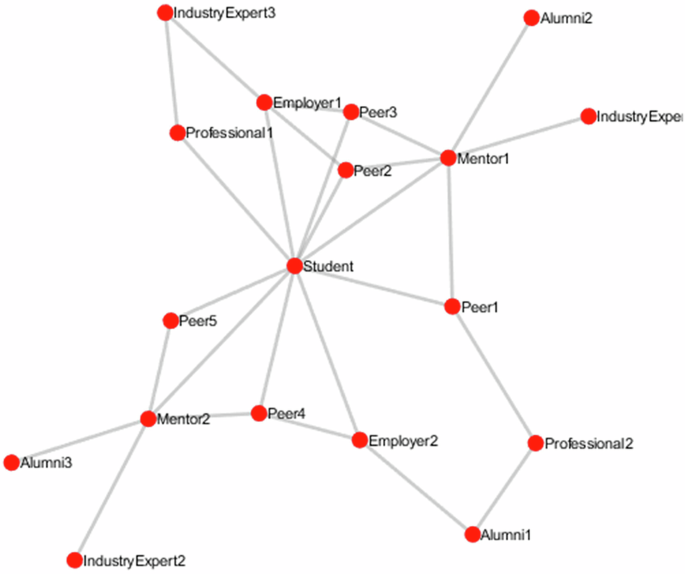
To comprehensively evaluate the social network of students in their career development, the study collects career social network data through questionnaires, interviews, social media, and career network platforms. The questionnaire collects students’ career development path data, covering job positions, industry backgrounds, and career promotions. The questionnaire also asks students to provide social network information related to their careers, focusing on the frequency of contact, degree of cooperation, and resource sharing with peers, mentors, industry experts, and employers. Data collection is carried out through online questionnaires and face-to-face interviews to ensure the breadth and depth of information. All collected data are collated and anonymized to protect the privacy of participants. These data provide a basis for subsequent SNA and support in-depth exploration of the relationship between students’ social networks and career development, as shown in Fig. 1.

Nodes represent students or their contacts (peers, mentors, employers, industry experts), and edges represent the connections between them. The network structure visualizes the composition and resource distribution of students’ career networks, highlighting differences in social capital among students from different social backgrounds.
Figure 1 shows the social network structure of students in their career development. Nodes represent students or their contacts (peers, mentors, employers, industry experts, etc.), and edges represent the connections between them. The intuitive display of the composition and structure of students’ social networks helps to explain the position of students from different social backgrounds in the network and the distribution of resources.
In network analysis, students are regarded as nodes in the network, and their professional relationships are represented by the lines between nodes. Based on the social network data provided by students, the social network structure of each student can be constructed. Network density reflects the ratio between actual connections and possible connections in a social network and measures the closeness of social resources available to students in their career development. The density of each student’s social network is calculated to analyze whether students from different social backgrounds can obtain the same network resources. A high-density social network usually means smoother information flow and more convenient resource acquisition. By comparing the network density of different groups, it is explored whether factors such as social class and race affect the density of student networks. Network centrality analysis focuses on evaluating the importance of students in their career networks. By calculating the degree centrality, closeness centrality, and betweenness centrality of nodes, students’ core position in the network and their ability to circulate information are evaluated. Degree centrality reflects the number of contacts that a student is directly connected to; closeness centrality measures the average distance between a student and other nodes; betweenness centrality shows the bridge role that a student plays in information flow. Students with high centrality are usually able to obtain more career opportunities and resource support. Through the centrality index, whether students from different social backgrounds are in a central position in the network can be analyzed, so as to obtain more career resources and opportunities.
Network density is calculated by dividing the actual number of connections in the network by the maximum possible number of connections:
$${Density}=\frac{2L}{N(N-1)}$$
(1)
Among them, L is the number of observed ties, and N is the number of nodes. Higher density indicates stronger group cohesion and resource sharing.
Centrality measures include degree (number of direct connections), closeness (average shortest path to other nodes), and betweenness (frequency of acting as a bridge between disconnected groups). These metrics are computed using social network data collected from student questionnaires, LinkedIn profiles, and alumni records, and analyzed via Gephi software to visualize and quantify career-related social capital.
In the SNA framework, social capital refers to the resources that individuals obtain from social relationships, such as information, opportunities, and support. This study focuses on the social capital that students rely on in their career development, analyzing industry connections, resource allocation, and information exchange. The SNA method is used to evaluate the industry resources that students are exposed to and their contribution to their career development, track resource flow patterns, and reveal the impact of social inequality on resource acquisition. Studies have shown that students with superior socioeconomic backgrounds tend to have access to more network resources, which is crucial for job hunting and career advancement. The network resource flow path is evaluated to study how social background affects the acquisition of career opportunities. It is found that there are significant differences in the opportunities obtained by students from different social backgrounds in the career network. Students from low socioeconomic backgrounds lack industry connections and information support in the early stage, which leads to more prominent inequality in their career development process.
link
More Stories
Staying authentic: Why your foundation matters more than ever in career growth
Insurance career program offers personal lines training
ISSA To Host Global Virtual Summit for Personal Trainers, Fitness Brands