






Text by | Zhou Xinyu
Edited by | Su Jianxun
Since 2025, the keyword for Deng Jiang has been: going against the current.
At the beginning of the year, as a business partner and vice president of commercialization at Baichuan Intelligence, Deng Jiang witnessed the impact of DeepSeek and the upheaval among the “Six Big Tigers” of large models. The ToB business he led was announced to be dissolved, and Baichuan’s business was consolidated into consumer – oriented AI healthcare.
Amid the turmoil, Deng Jiang chose to leave Baichuan and start his own business.
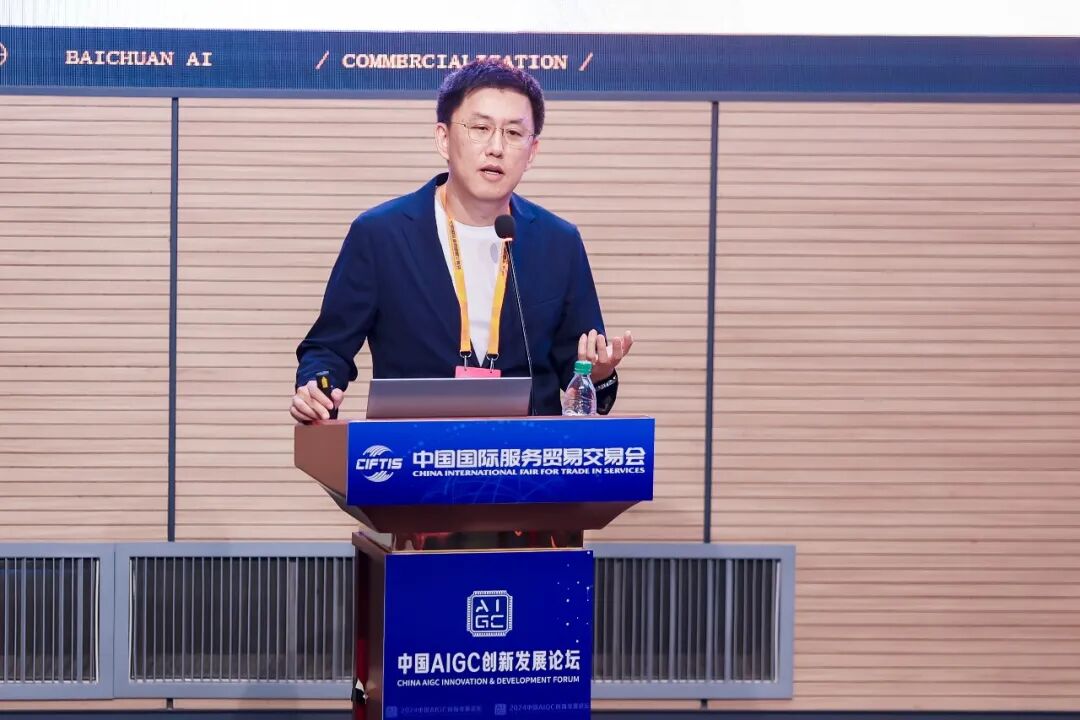
△ Deng Jiang, former business partner and vice president of commercialization at Baichuan Intelligence, and founder & CEO of Yuanqi Intelligence. Image source: Provided by the interviewee.
Surprisingly, his company, “Yuanqi Intelligence”, neither directly focused on AI applications nor entered the financial field where he was proficient. Instead, it made the same choice as Baichuan: From model training to application development, it is deploying in AI healthcare.
As is well – known, the healthcare field is a tough nut to crack. On one hand, there is a complex and closed healthcare system; on the other hand, there is intense resource competition from tech giants like Ant and JD.
The doubts have never stopped.
Some questioned Deng Jiang’s financial background. As an experienced financier from institutions such as the head office of the Agricultural Bank of China, Chang’an Xinsheng, and Zhongguancun Kejin, he doesn’t fit the typical profile of a medical expert.
Others questioned the “survival rate” of startups in the healthcare track. To this day, Deng Jiang is still often asked during the financing process: What can you use to compete with tech giants?
Before meeting Deng Jiang, we also had a question: After witnessing Baichuan’s AI healthcare business for more than two years, what exactly gave Deng Jiang the confidence to enter the arena?
His answer is: It is precisely Baichuan’s experience that proves the feasibility of commercializing AI healthcare in the era of large models.
AI healthcare is not narrowly defined as “in – hospital diagnosis and treatment”, but rather encompasses a broader range of intelligent health management scenarios such as elderly care and medical insurance. These scenarios are closely related to the financial fields such as banking and insurance.
Deploying in finance is for the sake of deploying in healthcare. This was also the core reason why Deng Jiang chose to join Baichuan Intelligence and establish the financial business group in early 2024.
During his more than one – year tenure at Baichuan, Deng Jiang achieved a “commercial closed – loop” in the implementation of AI in health scenarios such as insurance and elderly care. In terms of both revenue and cooperation willingness, the ToB business became the core of Baichuan’s commercialization.
These “pan – healthcare” health scenarios also became the focus of Yuanqi Intelligence after its establishment.
After leaving Baichuan Intelligence, Deng Jiang decided to lead his team on a new path.
The first difference between the two lies in Baichuan focused on pure text, while Deng Jiang chose multi – modality.
From the perspective of implementing healthcare models, Deng Jiang believes that “Medical problems must involve ‘observation, auscultation, inquiry, and palpation’; they are multi – modal and cannot be clearly described only through text.”
This view also determines the technical route of Yuanqi Intelligence: Develop a multi – modal medical evidence – based model.
Within six months after its establishment, based on four or five domestic large – size multi – modal models for reinforcement training, Yuanqi Intelligence trained its own underlying multi – modal medical evidence – based model.
In November, based on its self – developed model, Yuanqi Intelligence released its first commercialized AI healthcare intelligent agent, MentX. In the internationally authoritative medical multi – modal reasoning evaluation set MedXpertQA, MentX ranked second globally and first in China.
Deng Jiang told us that the accuracy of MentX in answering real and common medical questions reached 95%, placing it in the first echelon in China.
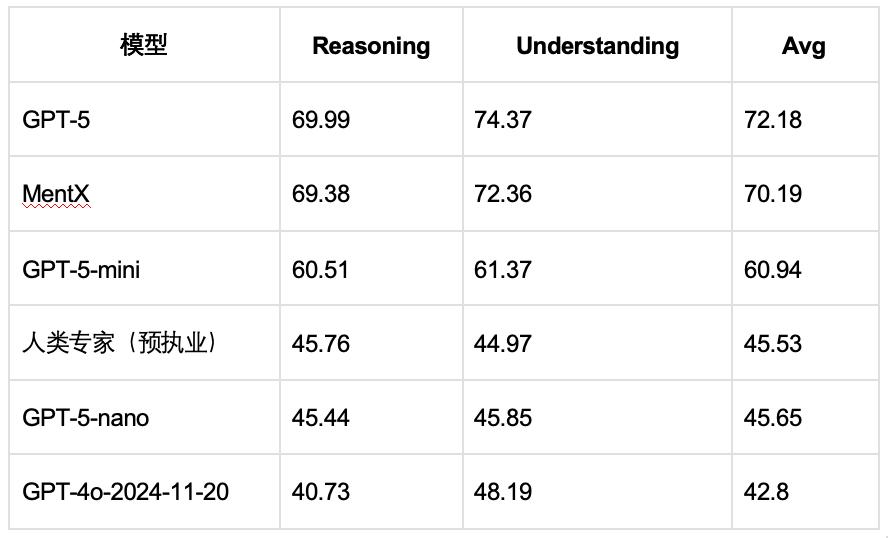
△ In the MM subset list of the international medical multi – modal reasoning evaluation set MedXpertQA, MentX outperformed GPT – 5 – mini. Image source:
The second difference is that Baichuan chose the ToC approach, while Deng Jiang bet on ToB.
By providing the MentX API, Deng Jiang established partnerships with enterprises and institutions in industries such as elderly care, insurance, and medical aesthetics.
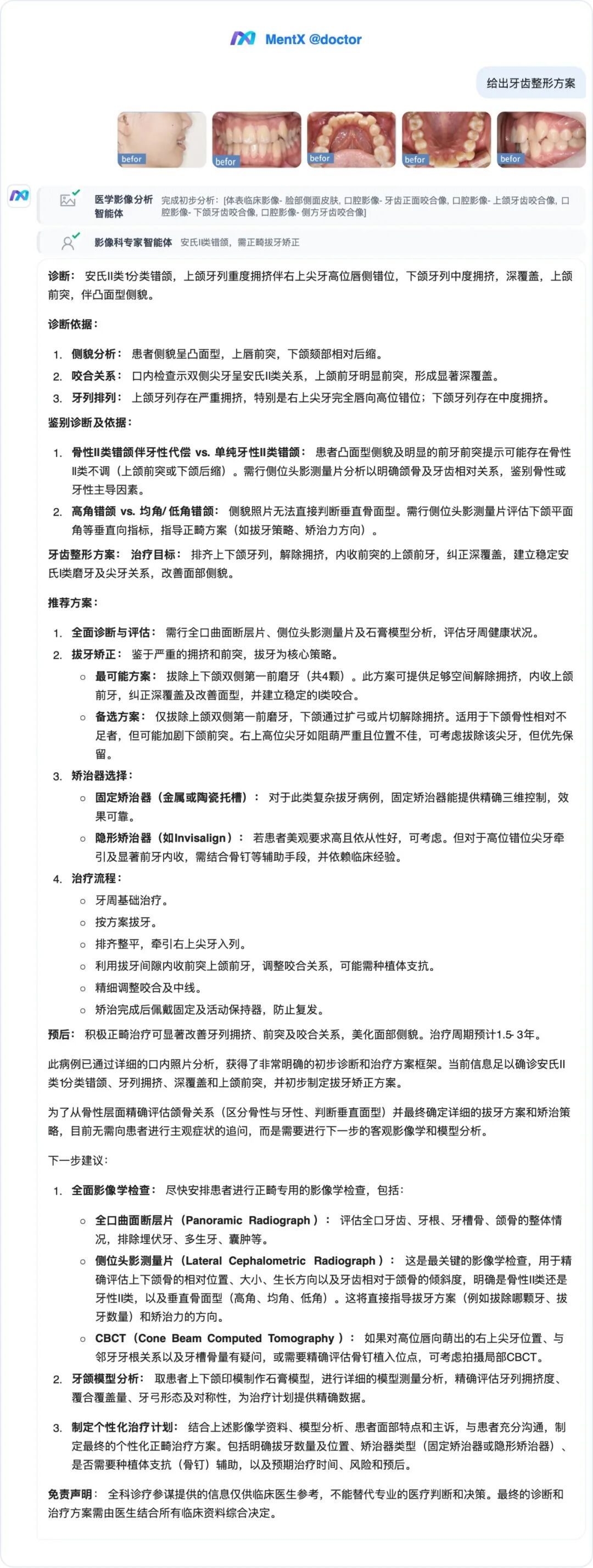
△ Orthodontic advice given by MentX. Image source: Trial use of MentX.
Choosing the ToB approach is not just a matter of path dependence for Deng Jiang. He told us that at present, more high – quality multi – modal healthcare data comes from the B – side. For startups that urgently need to build data and scenario barriers, delving into the B – side first is a wise choice.
After achieving a technological breakthrough, Deng Jiang entered a field he was more familiar with: First, sell AI healthcare products to his familiar B – side customers in industries such as insurance and banking to set the commercialization and data flywheel in motion, and then gradually expand the business territory to a broader health field.
Deng Jiang told us that although the company has only been established for three months, it has already signed three commercial contracts.
Completing the chain from technological verification to commercial implementation in just half a year, on the other hand, has led to doubts about the low business barriers.
Being sufficiently focused and focusing on complex scenarios – this is Deng Jiang’s methodology for building barriers.
“We don’t do medical Q&A chatbots, nor do we do simple symptom consultations.” He told us that Yuanqi Intelligence focuses on complex medical decision – making scenarios that require combining different modalities of medical images and medical reports and involve multiple departments.
For example, how to accurately interpret a physical examination report that includes medical images such as CT, X – rays, and electrocardiograms, as well as test data.
In real – world medical scenarios, complex decision – making has real value. “He summarized, “We hope to do complex things. In the future, there won’t be many companies in China that can provide such technical services.”
Doing finance is for the sake of doing healthcare
Intelligent Emergence: Your previous background was more in finance. Why did you choose to start a business in AI healthcare?
Deng Jiang: This is also the question people have asked me the most recently. Maybe it’s because people have had a misunderstanding of healthcare in the past.
Healthcare is actually a knowledge system, not equal to hospitals or doctors. This knowledge system actually has many application scenarios.
The reason why Baichuan got involved in finance is that in scenarios such as health consultations, underwriting, and claims settlement in insurance, and elderly – care finance in banking, there are a large number of healthcare – related needs, and there are excellent opportunities for a commercial closed – loop.
For example, when buying insurance, making insurance claims, or underwriting, people who understand healthcare are needed for relevant work.
So what I’m doing now is actually using the technological revolution brought by large models to supply healthcare capabilities to scenarios in the broader health industry outside of hospitals, such as banking, insurance, and medical aesthetics.
Intelligent Emergence: Does it mean that Baichuan’s purpose of doing finance was to do healthcare?
Deng Jiang: At Baichuan, we promoted our healthcare solutions to financial institutions. For example, to insurance companies, we promoted our health consultation capabilities in the insurance sales process and our underwriting and claims – settlement capabilities after insurance.
For another example, with banks, we cooperated with some leading banks to implement elderly – care finance scenarios.
Intelligent Emergence: You joined Baichuan in early 2024. How was the progress of AI healthcare that year?
Deng Jiang: At that time, the commercialization of large – model technology in in – hospital scenarios was unable to form a commercial closed – loop due to regulatory policies and model capabilities. At that time, the capabilities of medical models could not meet the requirements for complex decision – making at the diagnostic level.
So some companies in the US and China saw opportunities for a closed – loop in “pan – healthcare scenarios”, such as insurance. Some healthcare products launched by companies like Alibaba and ByteDance are not for in – hospital diagnosis but for out – of – hospital consultations, chronic disease management, physical examinations, etc.
These scenarios have lower requirements for healthcare capabilities than in – hospital scenarios, and they are more market – oriented and commercialized compared to the public – hospital and social – insurance – centered system.
Intelligent Emergence: What’s the significance of Baichuan’s experience for your entrepreneurship?
Deng Jiang: The large – model industry only started in 2023. I’m very grateful to Mr. Xiaochuan for leading us into this industry early on. This is very important to me.
Just like the earliest batch of Internet users and the earliest batch of mobile – Internet users, many successful entrepreneurs emerged from them because they witnessed the revolution brought by technology.
Secondly, I was in charge of commercialization at Baichuan. So in more than a year, I saw the market’s acceptance of new technologies and the potential for a commercial closed – loop. This also gave me great confidence in starting a business.
So although our company has only been established for a short time, there are many customers willing to cooperate with us. Everyone recognizes the explosive power of technology in the industry.
Intelligent Emergence: Why did you choose to start a business?
Deng Jiang: I left the company so that I could choose the technical path according to my own ideas.
I believe that medical problems must involve “observation, auscultation, inquiry, and palpation”; they are multi – modal and cannot be clearly described only through text.
Intelligent Emergence: Among language and multi – modality, why do you believe that multi – modality is a better path for medical evidence – based practice?
Deng Jiang: All language descriptions involve information loss. For example, when describing a world – famous painting in words, the images restored by the listeners will definitely be completely different.
So language is a good carrier for describing the world, but there is a large amount of information loss. For example, in online consultations and in – person consultations, the latter introduces more information input when meeting, and there are many things that cannot be described by language.
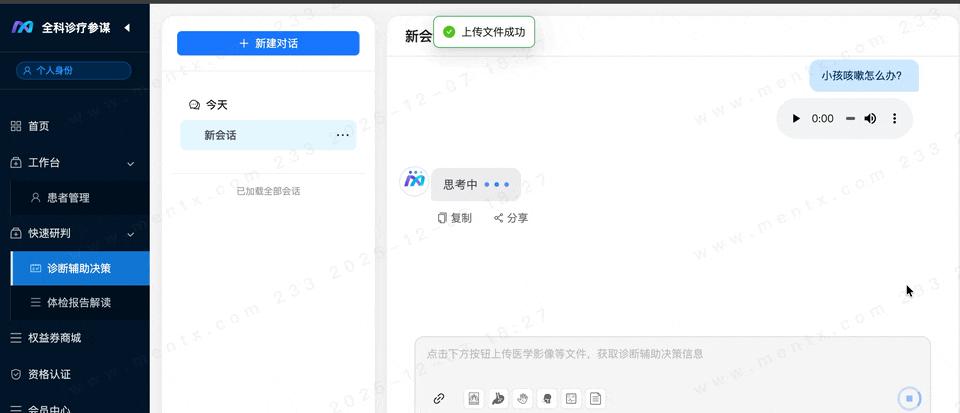
△ Diagnostic advice given by MentX after inputting a child’s coughing audio. Image source: Trial use of MentX.
Intelligent Emergence: Is this the right time to enter the healthcare field?
Deng Jiang: In 2023 and 2024, large – model technology was not ready for healthcare scenarios. This is why we chose to start this business in 2025.
In many application scenarios in the US, we have seen the commercial breakthroughs of the most advanced models in healthcare.
There is a gap of about half a year between China and the US. So we think this is the right time. I’m quite optimistic about the implementation of large models in healthcare scenarios next year.
Intelligent Emergence: What are the differences between customer acquisition in the healthcare field and in the financial field?
Deng Jiang: First of all, finance will still be an important scenario for us. We are also promoting some commercial cooperation with insurance companies and banks.
It doesn’t mean that I’ve given up on the financial field and started dealing with the National Health Commission and hospitals.
Secondly, the broader healthcare scenarios come from the institutions mentioned earlier, such as insurance companies, which serve a large number of people with healthcare needs and a large number of hospitals. Empowering insurance institutions to better serve these people is the business path we’ve chosen.
Intelligent Emergence: Does the team mainly focus on the B – side or the C – side?
Deng Jiang: Currently, we hope to create a “2B2C” path, that is, to first serve companies in the industrial chain and help them achieve more intelligent ToC services.
Intelligent Emergence: Why didn’t you choose the ToC approach like Baichuan?
Deng Jiang: We believe that more high – quality multi – modal data actually lies on the B – side, not the C – side.
We need an intermediate medium as our input source. For example, in the medical – aesthetics scenario, a professional salesperson must be equipped at the front – end of the product to guide users to upload photos from several angles. For example, first take a photo of the corners of the eyes, and then take a photo of the nasolabial folds.
It’s very difficult for patients to do these things on their own. For example, if a C – side product asks them to describe a rash or take a photo of their facial condition, patients may not know where to start.
So the role of professional front – end personnel on the B – side is to help us screen the input.
Maintaining technological independence is our biggest difference from tech giants
Intelligent Emergence: Is multi – modal medical evidence – based practice a consensus in China? Are there any companies taking the same route?
Deng Jiang: I dare not say that we are the only company taking this technical route, but I can say that among the publicly available products on the market, we are the only one with the ability to implement it.
Currently, none of the products on the market can support full – spectrum, multi – modal input.
Intelligent Emergence: Many medium – sized and large – sized AI healthcare companies that have been in operation for 5 or 6 years have achieved mediocre commercial results. Will your entrepreneurship be questioned?
Deng Jiang: Every time a new technology brings about an industrial revolution in history, it is always accompanied by doubts.
But I completely agree with Mr. Xiaochuan. Truly valuable things must be non – consensus in the early stage. When everyone reaches a consensus, the opportunity is gone.
Intelligent Emergence: How can you ensure that your company can be self – sustaining in the next few years and compete with tech giants at the same time?
Deng Jiang: First, we need to be more vertically and deeply involved in technology. This is the advantage of startups. Tech giants find it difficult to make such vertical investments. They make more general and broad – based technology investments.
Second, we need to maintain technological independence.
Intelligent Emergence: What does “technological independence” mean?
Deng Jiang
link
More Stories
Local entrepreneur being inducted into business hall of fame | West Prince Graphic
Global hub for technology and entrepreneurship
Michelle “Meme” Lovett Recognized for Entrepreneurship, Media Leadership, and Community Impact