





Theoretical background
Concepts of country-level entrepreneurship
The concept of entrepreneurship is multifaceted, with diverse definitions provided by various scholars. At the individual and firm levels, entrepreneurship is conceptualized as the process of initiating a business venture. This process encompasses the establishment, organization, and administration of a nascent enterprise, often a small business in its early stages, as delineated by Katila et al. (2012). Entrepreneurs, the individuals who embark on these ventures, are not only business proprietors but also key agents of innovation and change, embodying roles beyond mere management to include production and innovation, as Schumpeter (1934) elucidated. Furthermore, entrepreneurship is regarded as a decision-making process involving a choice between self-employment and wage employment. This perspective posits that individuals opt for entrepreneurial activities when the combined non-monetary and monetary rewards of self-employment surpass those of traditional employment, as argued by Murphy et al. (1991).
On a broader scale, country-level entrepreneurship is characterized by the cumulative rate of new business formations over a specified period, typically annually, within a given nation, as described by Wennekers (2006). This macro-level conceptualization of entrepreneurship is intrinsically linked to and contingent upon the entrepreneurial capabilities at the individual and firm levels. These capabilities include expertise in areas such as knowledge, economics, science and technology, market dynamics, and proficiency in devising and administering economic strategies at a macro scale.
From these various conceptions of entrepreneurship at different analytical levels, it becomes apparent that research focusing on the individual level concentrates on the attributes and contextual factors surrounding entrepreneurs. Consequently, this necessitates a consideration of country-level entrepreneurship as a research focus, adopting economic and management perspectives to elucidate the influence and significance of macro-level factors. This approach is pivotal for developing relevant policy recommendations for governments. Therefore, this research constructs its theoretical framework based on established theories in management science, specifically the Resource-Based View (RBV) and Transaction Cost Economics (TCE).
The country-level entrepreneurship in Resource-Based View
In Resource-Based View (RBV), the genesis of a firm’s competitive advantage is identified as stemming from its unique resources. Success in business is contingent upon the acquisition and effective combination of resources in a manner superior to competitors (Barney, 1991). Within this framework, Alvarez and Busenitz (2001) explored individual-level entrepreneurship, asserting that entrepreneurs possess distinctive resources, enabling them to identify new opportunities and assemble resources for ventures, thereby generating outputs that surpass market standards.
Extending the RBV to a national context, this study proposes that the collective entrepreneurial rate among countries hinges on their macro-level factors, which serve as vital inputs shaped by entrepreneurial vision and intuition. For the advancement of national entrepreneurship, a conducive and stable business environment is essential. This encompasses a transparent and equitable legal framework, political stability for investment predictability, advanced infrastructure, and education and training systems that equip entrepreneurs with necessary skills. Additionally, access to capital and resources is crucial for fostering national entrepreneurship. In essence, favorable macro conditions are imperative for the robust development and significant contribution of country-level entrepreneurship to a country’s economic and social progress.
Country-level entrepreneurship in transaction cost economics
The concept of transaction costs, introduced by Coase (1937) and elaborated in the Transaction Cost Economics (TCE) theory by Williamson (1981), posits that an economic entity is efficient when it minimizes the operational costs of the economic system, referred to as transaction costs. Dahlman (1979) categorizes these costs into three groups: search and information costs, bargaining and decision costs, and policing and enforcement costs. In the context of individual-level entrepreneurship, Michael (2007) and Stieglitz and Foss (2009) argue that an entrepreneur’s decision-making is influenced by their capacity to manage entrepreneurial costs. High entrepreneurial costs pose significant challenges for potential entrepreneurs, especially those with limited resources. Entrepreneurs, therefore, must judiciously assess these costs against prospective profits and strategize to minimize unnecessary expenditures while maximizing resource utilization.
Expanding TCE to encompass national entrepreneurship, this study posits that transaction costs in this context include the expenses from idea generation to new venture establishment (ex-ante costs) and the operational costs of a newly formed business (ex-post costs). These costs are pivotal in influencing entrepreneurial decision-making. The study suggests that facilitating entrepreneurial transactions can boost entrepreneurial motivation. Moreover, the interplay between transaction costs and national entrepreneurship is observable in the economic market equilibrium. Disturbances in this equilibrium necessitate adjustments in the price and quantity of entrepreneurial activities, leading to market entry by new businesses aiming to restore balance and pursue profitability.
The choice of determinant of macro-level entrepreneurship
The integration of the Resource-Based View (RBV) and Transaction Cost Economics (TCE) provides a robust theoretical foundation for selecting the key variables in this study. RBV emphasizes the strategic importance of national resources, such as human capital, technological infrastructure, and financial systems, in fostering entrepreneurial activity (Barney, 1991). In contrast, TCE focuses on the role of institutional efficiency, transaction costs, and economic integration in shaping business environments and reducing barriers to market entry (Williamson, 1981). By combining these perspectives, the study aims to offer a more comprehensive understanding of how macro-level determinants influence national entrepreneurship.
Economic factors, including GDP growth, Foreign Direct Investment (FDI), Economic Openness, and the Consumer Price Index (CPI), are crucial from both theoretical standpoints. From an RBV perspective, economic growth and FDI represent essential resources that enhance entrepreneurial opportunities by increasing capital availability, technological spillovers, and market expansion (Acs et al., 2013). TCE complements this view by highlighting how economic openness reduces transaction costs and fosters competition, making market entry more feasible for entrepreneurs. Additionally, CPI serves as an indicator of price stability, which can influence investment decisions and business sustainability (Baumol, 1990).
Social factors, such as education expenditures and unemployment rates, align closely with RBV’s emphasis on resource accumulation. Human capital, as reflected in education investment, is a key resource that enhances entrepreneurial capabilities, innovation, and productivity. Unemployment, on the other hand, may act as both a push and pull factor for entrepreneurship, as individuals seek alternative income sources in response to labor market conditions. TCE further informs these relationships by suggesting that social structures influence transaction costs, particularly in labor markets, where education levels and unemployment rates affect workforce efficiency and business viability (Djankov et al., 2002).
Institutional factors – including the cost of business start-up procedures, the number of procedures required to register a business, and the time needed to start a business – are central to TCE. These variables capture the regulatory and administrative barriers that affect entrepreneurs’ ability to enter markets efficiently. High transaction costs, stemming from excessive regulatory burdens, discourage entrepreneurship by increasing operational risks and initial capital requirements. Meanwhile, RBV complements this perspective by emphasizing that an efficient institutional framework can be viewed as a national resource that fosters innovation and economic dynamism (Audretsch and Keilbach, 2004).
The selection of the above variables is also based on a review of previous studies on important determinants of national entrepreneurship, as shown in Table 1 below.
By integrating RBV and TCE, this study systematically examines the distinct contributions of economic, social, and institutional variables to national entrepreneurship. Unlike prior research that primarily assessed their aggregate effects, this approach disentangles the specific influence of each indicator within a structured macro-level framework, providing a more nuanced understanding of cross-country variations in entrepreneurial activity.
Hypothesis developments on the relationship between macro factors and country-level entrepreneurship
Impact of economic factors on country-level entrepreneurship
From the perspective of the Resource-Based View, economic growth and foreign direct investment (FDI) play a crucial role in fostering entrepreneurial opportunities by enhancing access to capital, facilitating technology transfer, and supporting market expansion (Acs et al., 2013). Entrepreneurial initiatives often commence from a foundation of resources analyzed through macro-level logical assessments. Entrepreneurs typically begin by scrutinizing controllable macroeconomic conditions, which then inform the development of their entrepreneurial strategy, vision, and mission, ultimately laying the groundwork for future business successes. Consequently, advantageous macroeconomic conditions are instrumental in attracting both domestic and international investment, facilitating international trade, expanding production and business operations, and drawing entrepreneurial ventures (Castaño et al., 2015; Awoa Awoa et al., 2022).
Empirical research consistently affirms the influence of macroeconomic factors on national entrepreneurship. Castaño et al. (2015) emphasize that economic development fosters entrepreneurial activity, while Carree et al. (2002) note variations in entrepreneurship rates across different stages of economic growth. In general, strong economic growth – characterized by structural transitions from agriculture to industry and services – boosts investment, employment, and business creation. This shift lowers entry barriers, improves resource allocation, and enhances entrepreneurial opportunities.
Numerous studies confirm a positive link between GDP growth and entrepreneurship. Amorós et al. (2016) argue that sustained GDP growth fuels innovation and business formation. Sharma et al. (2023) further highlight the role of per capita GDP in fostering entrepreneurship by increasing savings and investment capacity. However, the direct impact of GDP remains debated. While economic growth generally signals a favorable business environment, Autio et al. (2014) caution that in developed economies, rapid GDP expansion may lead to market saturation, limiting entrepreneurial opportunities. These mixed findings suggest that the relationship between GDP and entrepreneurship depends on broader institutional and market conditions.
Moreover, policies on international trade and foreign direct investment (FDI) significantly and positively influence country-level entrepreneurship. Empirical studies indicate that when governments blend centralized planning and market policies with free market approaches, it stimulates imports and exports and attracts FDI, thereby encouraging domestic and international individuals to commence business ventures. Specifically, Shane and Venkataraman (2000) and Purkayastha et al. (2021) argue that economic openness fosters economic relations between countries, creating new business opportunities, where imports enhance domestic production capacity and product quality, while exports expand consumer markets, increase production activities, and generate financial rewards that encourage entrepreneurship. Additionally, Zhao (2022), Afi et al. (2022) and Sharma et al. (2023) found that FDI enhances a country’s income, improves the state budget, and enables financial accumulation, while also introducing advanced technologies, management practices, and expertise that enhance domestic technological and managerial capabilities, fostering entrepreneurship through learning and imitation.
Inflation is a key macroeconomic factor influencing country-level entrepreneurship. Moderate and well-managed inflation, reflecting a stable and growing economy, can foster a favorable entrepreneurial environment by ensuring predictable costs and investment returns. Román (1991) emphasizes the importance of government policies in maintaining price stability, which enhances business confidence and encourages new venture creation. The Consumer Price Index (CPI), a key measure of inflation, directly affects investment decisions and business sustainability (Baumol, 1990). A rising CPI, indicative of increasing inflation and currency depreciation, imposes financial burdens on entrepreneurs by escalating input costs, reducing purchasing power, and increasing market uncertainties. Persistently high inflation raises business expenses, including raw materials and wages, making it difficult for startups to manage costs and plan long-term growth. Moreover, inflation erodes consumers’ purchasing power, reducing demand for non-essential goods and services, which directly affects small businesses. Inflation also impacts access to credit, as higher CPI often leads to increased interest rates, making it more challenging for entrepreneurs to secure funding. Empirical studies support these findings, with Bjørnskov and Foss (2016) demonstrating that stable price levels and economic freedom positively influence entrepreneurship, while Li and Wu (2014) report a negative impact of high housing prices in Chinese cities on urban entrepreneurs. Although moderate inflation may stimulate economic activity, excessive CPI volatility undermines business confidence and hampers entrepreneurial growth at the national level.
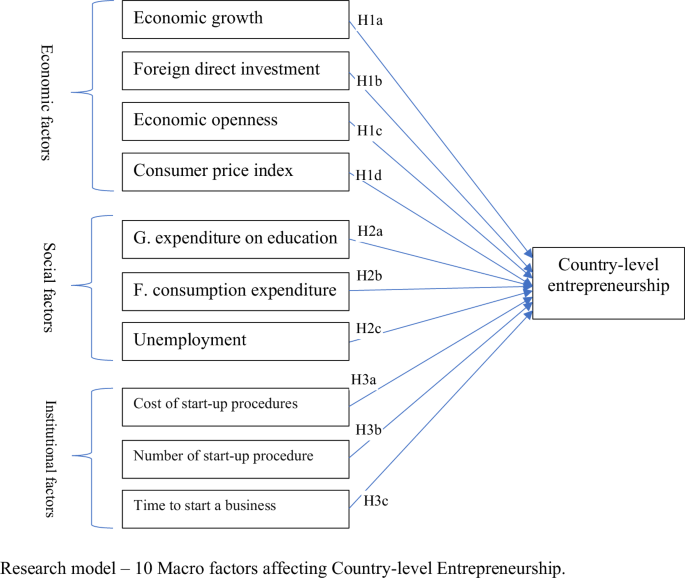
From these analyses, it is posited that favorable economic factors, providing adequate resources and opportunities, will enhance country-level entrepreneurship. As outlined above, the economic factors considered in this study will include economic growth, foreign direct investment, economic openness, and consumer price index. We assume that each of these factors influences country-level entrepreneurship. Consequently, we posit the first set of the following hypotheses:
Hypothesis 1a: Economic growth significantly and positively impacts country-level entrepreneurship.
Hypothesis 1b: Foreign direct investment significantly and positively impacts country-level entrepreneurship.
Hypothesis 1c: Economic openness significantly and positively impacts country-level entrepreneurship.
Hypothesis 1d: A higher Consumer Price Index (CPI) significantly and negatively impacts country-level entrepreneurship.
Impact of social factors on country-level entrepreneurship
While economic factors are instrumental in generating economic resources and market opportunities for prospective entrepreneurs, social factors equally play a crucial role in fostering entrepreneurship by creating a supportive environment conducive to economic and business development. This analysis delves into several key social factors.
Education and investment in educational initiatives are paramount in elevating the skill level of the population, a critical consideration for potential entrepreneurs contemplating business initiation. Education and training are pivotal in cultivating high-quality human resources for country-level entrepreneurship, equipping individuals with the necessary skills and knowledge for employment and entrepreneurial ventures. The positive correlation between education, training, and country-level entrepreneurship has been elucidated by Valerio et al. (2014). Additionally, Jiménez et al. (2015) examined the influence of education on entrepreneurship, finding that varying levels of education have different effects on formal and informal entrepreneurial activities.
The consumption level within a society is another factor that entrepreneurs consider alongside education when evaluating resources and conditions for starting a business. A rise in social consumption and growing domestic demand positively influence the consumer market and country-level entrepreneurship. Wennekers et al. (2005), in their study of 36 countries, demonstrated that an increase in population size and consumer market size, coupled with enhanced purchasing power, positively affects the rate of country-level entrepreneurship. Conversely, regions with low population density and weaker purchasing power face challenges in attracting investment and new business ventures compared to more populous and affluent areas. Policies aimed at stimulating consumer demand and promoting household spending can propel economic growth and influence business startup decisions (Matsuyama, 1992).
Unemployment rates and labor market conditions are additional social factors impacting entrepreneurial decisions. A low rate of unemployment positively influences economic growth, serving as a crucial metric for evaluating the effectiveness of economic policies, the quality of human resources, and national labor productivity. Stable employment and labor conditions can stimulate consumer expenditure and promote investment in economic development, thereby encouraging entrepreneurship. Research focusing on labor and unemployment policies to enhance country-level entrepreneurship (Amorós et al., 2016) suggests that policies fostering employment and wage incentives, or those aimed at increasing the rate of trained labor, positively impact investment activities and the establishment of new businesses. Furthermore, policies designed to attract labor in specific industries and regions, addressing labor shortages and the scarcity of high-quality labor in critical economic sectors, are essential and significantly influence country-level entrepreneurship.
While some studies argue that higher unemployment may encourage necessity-driven entrepreneurship, where individuals turn to self-employment due to a lack of job opportunities (Thurik et al., 2008), others indicate that persistent unemployment can hinder entrepreneurial activity by reducing overall economic stability and consumer demand (Audretsch et al., 2001). Moreover, unemployment-induced uncertainty weakens credit access, making it harder for potential entrepreneurs to secure funding for business ventures (Caliendo and Kritikos, 2010).
This study aligns with the perspective that high unemployment negatively impacts country-level entrepreneurship by limiting financial resources, increasing economic uncertainty, and reducing overall market opportunities for new businesses. Therefore, policies aimed at reducing unemployment and fostering a stable labor market are critical for sustaining entrepreneurial growth.
From these analyses, the positive impact of favorable social conditions in promoting country-level entrepreneurship is affirmed. We assume that each of these factors influences country-level entrepreneurship. Consequently, the second set of hypotheses are formulated as follows:
Hypothesis 2a: Government expenditure on education significantly and positively impacts country-level entrepreneurship.
Hypothesis 2b: Final consumption expenditure significantly and positively impacts country-level entrepreneurship.
Hypothesis 2c: Unemployment rate significantly and negatively impacts country-level entrepreneurship.
Impact of institutional factors on country-level entrepreneurship
Institutional conditions play a crucial role in shaping country-level entrepreneurial activity, complementing economic and social dimensions. Key factors such as the cost of business start-up procedures, the number of registration steps, and the time required to establish a business are central to Transaction Cost Economics (TCE). These elements reflect regulatory and administrative barriers that influence entrepreneurs’ ability to enter markets efficiently. Excessive regulatory burdens and high transaction costs discourage entrepreneurship by increasing operational risks and initial capital requirements. From the Resource-Based View (RBV), an efficient institutional framework serves as a national resource that fosters innovation and economic dynamism (Audretsch and Keilbach, 2004).
Extensive research demonstrates that the prevalence of national entrepreneurship is intricately linked to the institutional frameworks governing business operations, including factors such as the costs associated with business establishment, regulatory procedures for setting up a business, and the time required for business registration (Acs and Szerb, 2007; Pfeifer et al., 2021). Regulations concerning corporate income tax, entrepreneurial expenses, and transaction costs for new businesses (including information costs, property rights protection costs, operational costs, etc.), when stringently and judiciously delineated, can foster innovation and country-level entrepreneurship.
Among these factors, the cost of registering a new business plays a pivotal role in an entrepreneur’s decision to start a venture. Policies reducing corporate income taxes and other start-up fees attract new enterprises, while stringent regulations and high tax burdens can discourage entrepreneurship (Fonseca et al., 2001; Van Stel et al., 2007).
Efficient institutional frameworks also significantly impact entrepreneurial intentions. Simplified registration procedures, supported by administrative guidance, can streamline the process and encourage business creation (Sharma et al., 2023). Empirical evidence suggests that financial support policies, including investment incentives and government subsidies for operational costs, reduce barriers to entry and stimulate entrepreneurship. Additionally, non-monetary measures, such as administrative reforms, intensive training, and market linkage support, further enhance business viability and market penetration.
The speed and simplicity of business registration are also crucial. A streamlined process reduces unofficial costs, facilitates market entry, and attracts both domestic and international investment. Transparent economic policies encourage formal business registration while minimizing informal expenses. Furthermore, access to timely and comprehensive information, market research facilitation, and registration assistance empower entrepreneurs to maximize opportunities for growth (Nyström, 2008).
The total time required to establish a business – from initiation to operational readiness – is another critical consideration. Shorter, more efficient processes encourage entrepreneurship, while prolonged and costly registration deters it. This duration is largely influenced by national policies and support mechanisms, including financial and administrative assistance, which directly impact entrepreneurial activity (Van Stel et al., 2007).
These insights reaffirm the significant role of institutional factors in shaping country-level entrepreneurship. This study examines three key factors: business start-up costs, the number of required registration procedures, and the time needed to start a business, each of which is hypothesized to influence national entrepreneurship. Accordingly, the third set of hypotheses is formulated as follows:
Hypothesis 3a: The cost of business start-up procedures significantly and negatively impacts country-level entrepreneurship.
Hypothesis 3b: The number of start-up procedures required to register a business significantly and negatively impacts country-level entrepreneurship.
Hypothesis 3c: The time required to start a business significantly and negatively impacts country-level entrepreneurship.
Based on the development of the above hypotheses, we have constructed the research model as follows (Fig. 1).

link
More Stories
Local entrepreneur being inducted into business hall of fame | West Prince Graphic
Global hub for technology and entrepreneurship
Michelle “Meme” Lovett Recognized for Entrepreneurship, Media Leadership, and Community Impact