





Article content
The trade talk between the United States and Canada is creating a sense of uncertainty within P.E.I.’s home and construction industry, with builders and real estate professionals closely watching how tariffs could affect material costs and housing prices.
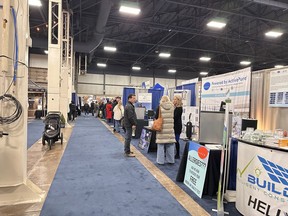
Aaron McCardle, owner of McCardle Home Builders, told The Guardian during the P.E.I. Provincial Home and Outdoor Show on March 8 that customers are becoming worried about the unknown, but there are some reasons to be optimistic.
Article content
“With interest rates coming down over the past year, that’s a positive thing too, which is going to help, maybe counterbalance the tariff issue versus the bank interest rate for loans.”
McCardle’s company specializes in selling both pre-built homes and custom-building houses for clients. While his company sources most materials domestically, he said he’s concerned about the broader financial strain on customers.
“Since it may be costing us more to buy a car or to buy groceries or to buy the things that do come from the States that have a tariff on them, they don’t have that extra money for a down payment to build a new home or to get a mortgage or to do a renovation,” he said. “They only have so much money that can go around. So that’s what I’m a little worried about.”
Building costs
Joe MacKenzie, territory manager at Cape Cod, a wood siding company, said that 90 per cent of the materials his company uses —primarily lumber — come from Western Canada. However, certain key construction items, such as nails and paint, are imported from the U.S., making them vulnerable to trade policies.
Article content
“The paint and nail portion of our business would probably make up about 10 per cent of the product. So, it could have a small effect on it. My bosses aren’t worried about it, so I’m not worried either.”
When asked if his company was seeking Canadian alternatives, MacKenzie said they would consider switching suppliers only if they could ensure the same quality.
“Our paint manufacturer is a multinational paint manufacturer. They’re very good at what they do, and we rely on them to give us the best product, and we get the best product from them. So, we will, we’ll have to continue using them,”

Real estate
Francis Theriault, owner of real estate company P.E.I. Agents, said that while the real estate market remains hot, uncertainty looms over whether rising costs from tariffs will eventually drive up home prices.
“Obviously, everything that is more expensive for us will be more expensive. So, that’s the ripple effect for customers.”
However, he also noted that the trade dispute could create unexpected benefits.
“Since there will be more people buying Canadian materials, maybe we will have a surplus here with what we produce, and the prices will be adjusted for the better,” he said. “It’s just too early to know.”

Theriault said that potential homebuyers frequently ask if now a good time is to purchase property.
“The Bank of Canada is following what’s going on with the U.S. Right now, it’s still good. The market is very hot, on the positive side,” he said. “So probably in a couple of months from now, we’ll have a better idea.”
Vivian Ulinwa is a reporter for The Guardian in Prince Edward Island. She can be reached at [email protected] and followed on X @vivian_ulinwa.
Recommended from Editorial
-

Tariffs lead P.E.I. restaurants to look for alternatives to U.S. goods
-

P.E.I. craft breweries brace for impact of U.S. tariffs
Share this article in your social network
link
More Stories
US president’s son Eric Trump invests in drone maker with gov’t contracts | Military News
Private Construction Promises Strong Season; Questions Remain for Public Spending
Broadway Plan construction pushing restaurants to the brink