





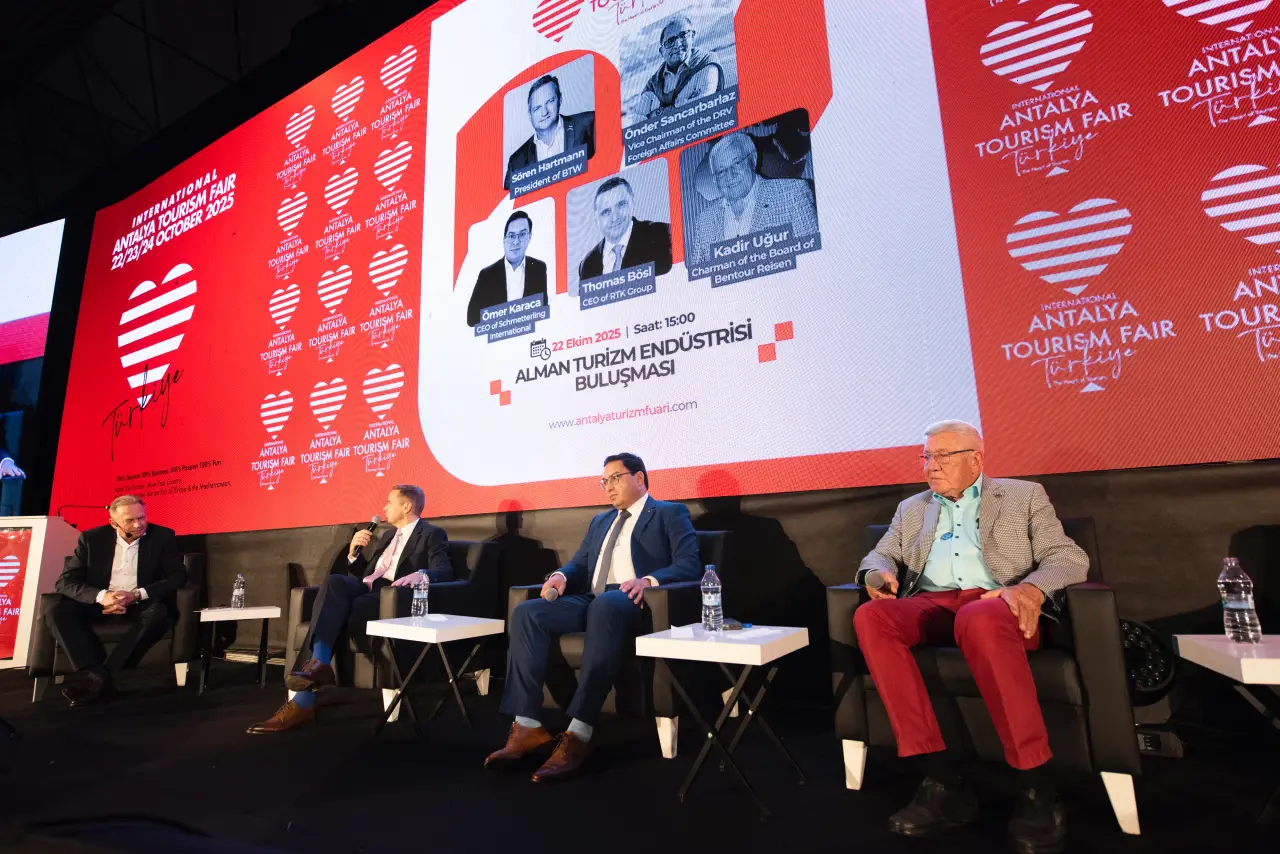
Tourism leaders from Germany and Turkey convened at the International Antalya Tourism Fair (ATF25) to discuss the future of Turkish tourism and its strategic ties with the German market.
The “German Tourism Industry Meeting” panel, held from 22 to 24 October 2025 at the ANFAŞ International Fair Center in Antalya, gathered leading figures from the tourism sector to explore opportunities, challenges, and collaboration strategies between the two countries.
The seventh edition of ATF25, organized under the theme “Sustainable Hospitality,” brought together key industry stakeholders from across the globe. Sponsored by Türkiye İş Bankası and partnered by Kilit Hospitality Group, the event underscored Turkey’s growing position in the international travel market. The German Tourism Industry Meeting was among its most anticipated sessions, focusing on how Turkey can maintain growth and innovation in an increasingly competitive landscape.
Turkey and Germany Strengthen Tourism Cooperation
The panel was moderated by Sören Hartmann, President of the German Tourism Industry Association (BTW), and included Önder Sancarbarlaz, Vice Chairman of the Foreign Affairs Commission of the German Travel Agents Association; Ömer Karaca, CEO of Schmetterling International; Thomas Bösl, CEO of RTK Group; and Kadir Uğur, Chairman of Bentour Reisen. Together, they discussed tourism’s economic role, digital transformation, and new market opportunities.
“Turkey has always been an important tourism destination for Germany,” said Sören Hartmann. “The cooperation between Turkey and Germany is an important example not only in tourism but also in cultural relations. The growth Turkey has shown in recent years has directly impacted my career.” Hartmann emphasized that Turkey’s tourism accounts for 12% of its GDP and noted that 6 million German tourists visited Turkey in 2024, reinforcing the country’s appeal as a preferred destination.
Önder Sancarbarlaz highlighted the economic value of Turkey’s tourism to Germany, stressing that beyond visitor numbers, tourism fosters cultural exchange and strengthens bilateral relations. “Germany remains Turkey’s largest tourism market. In 2024, 12% of Turkey’s GDP came from tourism. This is a crucial contribution to the Turkish economy,” he said.
Innovation, Digitalization, and Market Expansion
The discussion also focused on digitalization and market diversification as essential tools for sustaining growth. Ömer Karaca, CEO of Schmetterling International, underscored the importance of technology in the industry’s transformation. “Digitalization in the tourism sector is not just about software; it represents a transformation that changes the way we do business. We must accelerate the digitalization process to meet customer expectations,” he said. Karaca added that investments in digital infrastructure would enable Turkey to reach new markets and deliver higher-quality services.
Despite recent economic challenges, Thomas Bösl , CEO of RTK Group, expressed confidence in Turkey’s tourism recovery. “2025 was a tough year. However, Turkey has always been a strong destination. I’m optimistic for 2026. We must be careful with prices, as price increases could lead to the loss of some market segments,” he said. Bösl also urged a stronger focus on health and wellness tourism to diversify beyond traditional “sun and beach” offerings.
Echoing the sentiment of expansion, Kadir Uğur, Chairman of Bentour Reisen, pointed to new investment opportunities in Scandinavia. “Our investments in the Scandinavian market, particularly our adoption of a non-price-focused tourism approach, offer us a great opportunity to create a strong market. Our agreements with TUI will enhance our impact in this area,” he said.
Concluding the panel, Sören Hartmann reiterated the optimism shared among participants. “We trust in the quality of Turkey, and we must work together to deliver this quality to an even wider customer base,” he said. The discussion at ATF25 reflected a unified vision of resilience, modernization, and collaboration as Turkey continues to expand its tourism influence within Europe and beyond.
Speakers framed Turkey’s next phase of growth around concrete steps: building digital capacity to improve booking and service efficiencies, broadening the country’s offering beyond seasonal beach travel, and cultivating new source markets to balance demand. The emphasis on wellness and health tourism aligned with evolving consumer preferences, while Scandinavian investments and partnerships aimed to offset softness in traditional segments. Taken together with the “Sustainable Hospitality” theme and the event’s broad backing from financial and hospitality partners, the panel signaled a coordinated push to keep Turkey competitive and resilient heading into 2026.
link
More Stories
2026 Shropshire Business Awards: A Renewed Focus on Tourism and Innovation
IS YOUR BUSINESS VISITOR READY?
2026 Tourism Climate Adaptation and Environmental Sustainability Business Survey Launches – Destination BC