





Toward the end of August 2024, nearly a year into the Gaza war, a leading Hebrew news podcast devoted an episode to the absence of Palestinian construction workers from Israeli building sites. “The Zionist dream is built on Palestinian labor,” said the journalist who had prepared the report. He was offering a rueful paraphrasing of the pioneering generation’s ideology, which emphasized the value of so-called Hebrew labor as an expression of self-sufficiency. But that ideal was always more of an aspiration than a reality, as the journalist acknowledged.
Israel has benefited from cheap Palestinian labor since 1967, when it first occupied Gaza and the West Bank. During the 1970s and 1980s, there was freedom of movement between Gaza, Israel and the West Bank. This was before the walls and checkpoints, when Palestinians from the occupied territories made up a massive, readily available source of casual labor for all the physically demanding jobs. The security services did not regulate the system, except to arrest Palestinians caught staying overnight in Israel, which was illegal, though very common. Palestinians from the occupied territories cleaned buildings, swept streets, paved roads, built apartments, prepared restaurant food and harvested crops. They managed the kitchen at the restaurant where I waited tables on weekends and spoke better Hebrew than the American and Australian settlers who owned it. When I was a student at the Hebrew University in Jerusalem, Palestinians cooked and served the food in the cafeteria, cleaned the toilets and washed the floors in the corridors. I knew Israelis who hired Palestinians to babysit their children, clean their houses and landscape their gardens. The closure system Israel imposed on the occupied territories beginning in the mid-1990s put an end to this kind of casual labor system. First, the government tried to end Israel’s dependence on cheap Palestinian labor by importing workers from places like Southeast Asia, India, China and Nepal. Later, they introduced the permit system for construction workers. This is a corrupt system that goes through Palestinian contractors who charge a fee. Distilled to the bottom line: Israel has benefited economically from cheap labor that also helps it maintain control over the Palestinian population.
Contemporary Israelis place great importance on owning a home, without thinking much about the ethnicity of the people who build it. Now, many couples are seeing their dream deferred because the government, specifically the far-right minister of national security, has revoked the entry permits of West Bank Palestinians, who on the eve of the Oct. 7, 2023, attacks, made up the vast majority of construction workers. As a consequence, Israel is experiencing a severe labor shortage. All over the country, the once noisy sites of half-built apartment blocks have gone silent, while where work is ongoing, the pace has slowed noticeably. Work on several buildings in Tel Aviv that had been well underway in 2023 was barely plodding along when I returned in May 2025, and it seemed to have progressed only incrementally. Other building sites looked abandoned, though the scaffolding was still in place.
The workers I saw last spring were from China and sub-Saharan Africa. A friend who had told me the year before of her plans to renovate her house now said she’d postponed the project indefinitely because it had become unaffordable: The few available workers were asking more than double the fee she’d been quoted when Palestinian labor from the West Bank had been on hand. Work on the Tel Aviv light rail, for which the city’s main thoroughfares had been dug up, causing unbearable traffic jams and elevated air pollution, had slowed to a crawl. Contractors were going bankrupt. In 2024, the construction sector lost 98 billion shekels (around $31 billion at today’s exchange rate), according to the Central Bureau of Statistics. This amounted to about 4.9% of Israel’s gross domestic product and nearly 45% of the industry’s output that year. All told, from October 2023 to October 2025, the Israeli construction industry lost a total of 131 billion shekels. Meanwhile, tens of thousands of West Bank Palestinians with work permits and years of experience are languishing on the other side of the wall, unemployed and desperate.
Before October 2023, at least 120,000 Palestinians from the West Bank had permits to work in Israel, while an additional 40,000 had permits to work in the Jewish settlements, with most employed in the construction sector and some in agriculture or industry. In addition, Israeli human rights organizations estimate that at least 40,000 Palestinians without permits smuggled themselves into Israel every day in search of work. The Palestinians who worked legally in Israel were paid around 8,000 shekels per month, which is only half the average salary for an Israeli but two or three times the amount a university-educated civil servant could earn in the Palestinian Authority. As Joshua Angrist, the 2021 Nobel laureate in economic sciences, noted in a famous 1990s study, in the West Bank, a Palestinian plasterer earns more than a physician. The workers who had jobs in Israel earned enough to support a large family, build a home and buy a car. Their incomes accounted for about one-third of the West Bank’s GDP.
And so when, the day after the Hamas attacks, Minister of National Security Itamar Ben-Gvir revoked their permits, the consequences were immediate and calamitous. The West Bank Palestinian economy contracted by 30%, per capita income declined by about 21% and 300,000 people, out of a population of about 3 million, were suddenly unemployed. In many cases, perhaps the majority, the newly unemployed people had been the sole wage earners for a family of 10 or more. The P.A. was already cash-strapped, largely because of Israeli policies, notably the withholding of tax revenues. It not only slashed the salaries of civil servants yet again, but also started paying them weeks late. Within months, families that had lived comfortably on a construction worker’s salary were reduced to penury. First, they spent their savings, then they sold the family’s gold jewelry and within a few months they went into debt. A senior executive at one of the Palestinian banks told me that many of these men were particularly vulnerable to the negative impact of unemployment because, since their salaries as construction workers in Israel had been deposited directly into their accounts, with pay stubs showing deductions for Israeli national insurance benefits, they had the necessary documentation to apply for house and car loans, which the Palestinian banks had been granting quite liberally. Now the unemployed construction workers couldn’t meet their loan payments, which was, of course, a problem for the banks too.
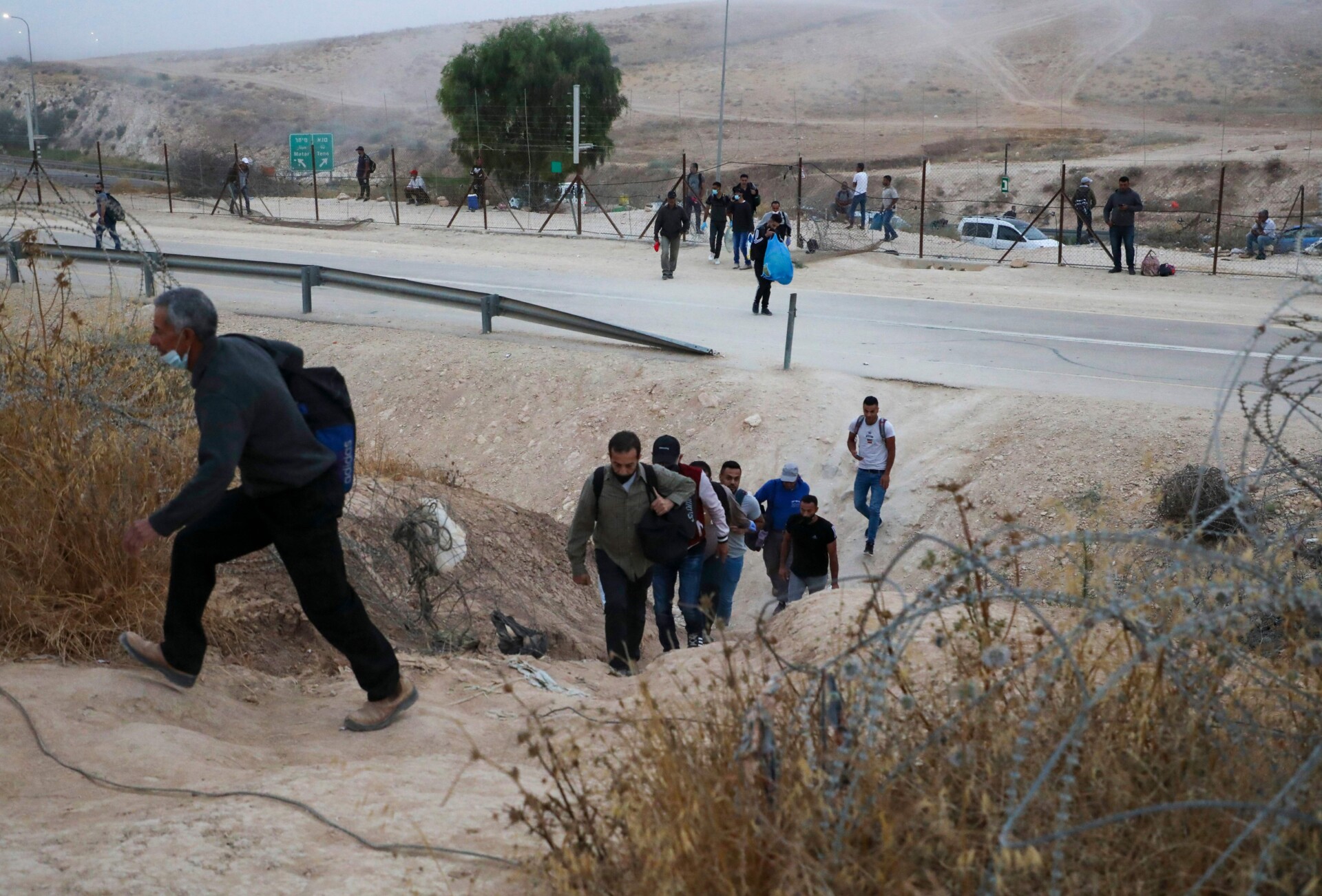
Reports published by the World Bank and the International Labor Organization used adjectives like “devastating” and “unprecedented” to describe the rapid disintegration of the West Bank economy. Thousands of men desperate to feed their families are smuggling themselves into Israel, often at great expense and despite the significant risk, to work illicitly for cash. But they are no longer able to count on a regular monthly income, and they are vulnerable to employer exploitation, arrest and even to being killed. Those who do find work and succeed in smuggling themselves into Israel can’t run the risk of going home often, so they hide out. In January 2025, Haaretz reported that men were hiding in nature preserves and sleeping in makeshift tents constructed of tarpaulins and scrap wood, with no sanitary conditions or protection from the elements. One man told the Haaretz reporter: “If it were not for the fact that I have a family and children who I need to provide for, I would prefer to kill myself and not have to live like this.”
Expressions of compassion for Palestinians have become practically taboo in mainstream Israeli discourse since the Oct. 7 attacks, so the reporter on the Hebrew news podcast, who in any case is not known to hold particularly liberal views, framed the banning of Palestinian workers from the occupied territories as bad for Israel. Not only was the labor shortage hurting the Israeli economy and exacerbating the shortage of affordable housing, but it was creating a security risk. The Palestinian workers smuggling themselves in didn’t have permits, so they hadn’t been vetted by the security services, he said. For all these reasons, economic and security-related, he argued, it would be better for Israel to reinstate the system that had been in place before the war. These construction workers were not a security risk, he said. They were just ordinary men working hard to support their families.
He blamed Ben-Gvir, the notoriously racist, extremist minister of national security, for refusing to lift the ban on Palestinian workers. Prime Minister Benjamin Netanyahu, he said, understood economics and knew Israel needed Palestinian labor, but was unwilling to risk the stability of his coalition by overruling Ben-Gvir. Here, he offered what was a very standard mainstream analysis of Israeli coalition politics. Few people offered a different interpretation, one that would hold the prime minister responsible for the actions of his government: Perhaps Netanyahu simply did not care about the Palestinian workers or the cost of banning them from working in Israel.
A Palestinian colleague in Ramallah confirmed the reports of economic devastation, adding that she had interviewed several West Bank families who, within the space of months, had seen their standard of living plummet from prosperity to one haunted by food insecurity. But the story about construction workers barred from Israel was already well known, she pointed out. There was another construction story that had not been reported, and which she thought might be of interest.
Despite the wretched economic situation, the part of the West Bank known as Area A, under the full civil control of the P.A., seemed to be experiencing an inexplicable boom in low-rise residential apartment buildings that targeted a middle-class market. These were not the sprawling luxury apartments that were built for the richest 1%, people with lucrative businesses in other parts of the Middle East, senior jobs in the P.A., or high-level positions with international NGOs that paid American salaries. The apartments my colleague described were modest-but-comfortable three-bedroom units with mod cons like air conditioning, electric shutters and dedicated parking spaces. The odd thing, she said, is that they seemed to be sold but unoccupied. Also, the middle class in the West Bank had been financially wiped out. So who was buying these apartments? The answer, which emerged gradually during that spring reporting trip, is complex and often sad. It speaks to deeply felt, primordial needs like home, safety, prosperity and identity; it illustrates the outcome of Israel’s policy of categorizing different groups of Palestinians living in the territory it controls, between the river and the sea; and it demonstrates that Israel and Palestine are completely interdependent, though definitively unequal.
On a hot late spring day, my colleague and I drove around the outskirts of Ramallah as she pointed out the astonishing number of newly built and nearly complete low-rise apartment buildings that had sprung up in previously pastoral, empty spaces. We stopped at one of the low-rise buildings under construction and spoke with the contractors, who said it was planned as a boutique hotel, although there was certainly little demand for tourism in this highly volatile time and place. Samah, a 34-year-old worker from a nearby village, was taking a break from laying marble floor tiles that glinted in the sunlight to eat his lunch, a stuffed pita and a bottle of water, while sitting on an overturned plastic bucket that served as a makeshift stool. Blobs of dried white plaster were stuck to his dark blue cotton shirt, and his slumped posture conveyed weariness that was more than physical. He was receiving a relatively generous wage of 250 shekels per day for this job because, he explained, the contractors knew he was a skilled worker. The going rate for unskilled construction labor in the West Bank is 165 shekels for a full day’s work.
The tiling job was almost complete, and Samah was worried because he did not have any new projects lined up. Not that his life before October 2023 had been easy. Work on a construction site in Israel begins at 7 in the morning and ends at 5 in the afternoon, but for Palestinians from the West Bank, the workday is bracketed by a long, tedious and often humiliating journey through Israeli military checkpoints. For years he woke up at 4 in the morning and returned home at 8 or 9 in the evening. I asked: Five days a week? Samah looked at me and smiled a bit grimly. “Sittah,” he answered. Six. But he had earned a steady monthly salary, plus national insurance benefits, of at least 8,000 shekels and sometimes as much as 14,000 shekels, if the job required his skilled labor. The money was deposited directly into his bank account. “I just want to get back to working in Israel,” he said. We were speaking in May 2025; he had been without a regular income for over 18 months and was barely getting by on unreliable, low-paid, short-term projects. A week later, he made contact with his old employer in Israel, who was desperate for workers; he arranged for Samah to be smuggled in through a porous part of the checkpoint-and-wall system.
We found the answer to our question about the target market for the mysterious middle-class apartments by following a truck loaded with sacks of cement. It stopped at a construction site that, though it was just off the main road, felt isolated. There were no grocery stores or other amenities within walking distance of this residential project of about a dozen half-completed, identical three-story apartment buildings. There was one apartment per floor, each with electric window shutters, air conditioners and attached garages. One of the workers, who had been riding shotgun in the truck we followed, told my colleague in Arabic that he would ask the building site manager to speak with us. He used the Hebrew words for building site manager, which I took as evidence that certain expressions had been incorporated into the Arabic spoken by Palestinians in the West Bank, just as Israelis punctuate their speech with Arabic. My colleague, who didn’t know Hebrew, hadn’t noticed the words, but she did notice his accent. He’s from Gaza, she murmured. His name was Mohammed; he was one of the 18,000 Palestinian men from Gaza who had received a permit to work in Israel, which is where he was on Oct. 7, 2023. I learned more about his story during a follow-up meeting.
The building site manager was Omar, a 28-year-old civil engineer with dark curly hair, who wore navy blue chinos and a golf shirt. He was guarded at first, but opened up gradually. All the workers confided in him that they were desperate to get back to their jobs in Israel, which he understood completely. Everyone was deeply depressed about the situation in Gaza, he said. The war had been raging for 18 months, and now there were not only horrifying reports of famine, but sickening anecdotes of people being killed while waiting for food aid to be distributed. Omar told us that since there was now a glut of unemployed construction workers in the West Bank, Palestinian employers could impose all sorts of conditions, in terms of hours and wages, that would have been deal breakers when working in Israel had been an option. He described the apartments in the project we were standing in as standard middle-class units, each about 1,200 square feet. Homeownership was very important to Palestinians, he told me, adding that he and his wife had taken on significant debt to buy their own place and were now deeply worried because the economic situation was so dire. Speaking of which, we said, who is buying these apartments?
Omar looked down, then looked at me uncomfortably, hesitated and muttered: “Israeli Arabs.” I noticed that he did not call them “Palestinians” or “Palestinian citizens of Israel.” I was completely taken aback. I knew that East Jerusalem Palestinian residents, who had Israeli ID cards but not citizenship, were buying luxury vacation homes in new gated communities in the Jericho area; Bloomberg Magazine had published a feature about this phenomenon in August 2023, before the Gaza war. But ordinary Israeli citizens? It seemed so unlikely. Soon, however, I learned that this was a widespread practice. I interviewed Palestinian real estate agents in the West Bank who specialized in marketing to Palestinian citizens of Israel; if their luxury cars, well-appointed offices and nice wristwatches were any indication, they were doing well.
The Palestinian citizens of Israel that I knew were upper-middle-class professionals, artists and highly educated academics. They spoke unaccented Hebrew and moved comfortably in Jewish Israeli society. None of them owned apartments in the West Bank, though some had relatives who were P.A. residents. A Palestinian academic from Haifa, to whom I mentioned Omar and the apartment buildings, responded with an expression of mild curiosity, in a way that conveyed that the practice had nothing to do with him. So I pondered for a day until, inevitably, a 10-minute conversation with a taxi driver provided the insights I needed.
We were chatting while he drove me on the Jewish holiday of Shavuot to visit a sick friend who lived in Raanana, a prosperous middle-class town about 20 minutes’ drive from Tel Aviv. I was holding a bright yellow paper bag, which bore the logo of a hideously expensive shop that sold prepared foods and various imported delicacies — like cheese and wine from France or smoked fish from Norway. The shop always reminded me of the one Meryl Streep’s character owned in the Nancy Meyers movie “It’s Complicated.” That holiday morning, it was packed with well-heeled Tel Avivians sipping cappuccinos and eating croissants at the espresso bar, or insouciantly filling wicker shopping baskets without looking at the prices. The foreign media was full of the words “genocide” and “mass starvation,” but the Israeli media was silent about the Palestinians in Gaza and no one in Tel Aviv, outside the very small radical left circles, was talking about them either. People talked about the hostages or about the soldiers who had been killed, but not about the Palestinians — not even the tens of thousands of children who had been slaughtered. I found the refusal to poke through the denialism for the sake of the children the most difficult to take. The takeaway lunch for two cost me almost exactly what Samah earned for a day’s work laying tiles in Ramallah.
All these thoughts were running through my mind as I chatted with Mohammed, the taxi driver, in the comfortably informal Middle Eastern way that goes from stranger to best friend in five minutes or less. After he’d established that I had no children, didn’t live in Israel anymore and was spending far too much money on accommodation in Tel Aviv, I told him that I’d been in Ramallah the previous day and asked if he knew anyone who’d bought an apartment in that area. Without skipping a beat he said, “You’re looking at someone who bought an apartment in Ramallah. So did most of my friends.” I looked at him in the rearview mirror. Amazing. I felt as though I was channeling Thomas Friedman, the New York Times journalist who is the butt of jokes for his tendency to write foreign policy columns based on conversations with taxi drivers. So why had Mohammed bought a second home in Palestine?
“Listen, it’s a balagan here in Israel,” he said, using a Hebrew word for “mess” that is borrowed from Yiddish and Polish. “Everything is expensive, we work like slaves. In Palestine it’s quiet. There’s a view from the window, the air is fresh, the food is good, we can go to the swimming pool. The kids can play outside and I don’t have to worry about them. The shopping malls there are better than the ones here and much cheaper. The kids love going to the malls there. I can buy them what they want, we can eat out at restaurants and best of all, I feel at home there. Like a Palestinian.” His neighbors in the West Bank, he said, were mostly from “mixed” Arab-Jewish cities like Lod (al-Lidd) and Ramle. Significantly, both had seen serious violence during the May 2021 Arab-Jewish riots, with armed settlers who came in from the West Bank carrying out some particularly frightening attacks on Palestinian citizens of Israel.
Mohammed said that he’d bought the apartment, together with his brothers and his father, as an investment and as a holiday home. They were able to pay cash because a four-room, 1,100-square-foot apartment had cost 280,000 shekels. I spoke with several sales agents in Ramallah who specialized in selling new apartments to Palestinian citizens of Israel; they quoted me prices that were between 300,000 shekels and 400,000 shekels for 1,200 square feet, which matches the price range I found in online listings.
In Israel, the average cost of a 1,200-square-foot, 3-bedroom apartment is, according to data published in October 2025 by the financial newspaper Globes, about 2.3 million shekels. Tel Aviv is significantly more expensive. A current listing on a digital real estate board for an unrenovated, 750-square-foot, ground-floor apartment in an ordinary, not particularly central Tel Aviv neighborhood, is priced at 3.55 million shekels. Photos attached to the listing show a kitchen so small that the toaster oven had to be put on a shelf in the living room. It was listed at nearly 10 times the price of a significantly larger, brand-new, high-end apartment in Ramallah, reachable by car in half an hour if there are no delays at the checkpoints.
Mohammed the taxi driver said that his primary home was in Umm al-Fahm, the largest Palestinian city in the Wadi Ara and Triangle region that lies just inside Israel. It is a densely built-up city with few urban amenities, in an area where criminal gangs run unchecked by the Israeli police. Shooting incidents have taken the lives of 244 people in the past year alone; often, they are just innocent people caught in the crossfire. Meanwhile, a spike in anti-Arab racist incidents since Oct. 7 has made visiting shopping malls in Jewish-majority areas an uncomfortable experience for a Palestinian citizen of Israel who speaks Hebrew with an Arabic accent, who has a beard and whose wife wears a traditional head covering. Little wonder that Mohammed felt more comfortable in the Ramallah area. Unlike Palestinians who were residents of the P.A., he had freedom of movement and the protection of his Israeli ID card. And while he was working-class in Israel, in the West Bank, 45 minutes’ drive from his home in Umm el-Fahm, he could afford the lifestyle of the prosperous middle class. Counterintuitive and incredible as it sounds, the fact is that while roving bands of violent, emboldened extremist settlers are beating, shooting and ethnically cleansing Palestinian residents in one part of the West Bank, Palestinian citizens of Israel like Mohammed find peace and safety from the violence they experience inside Israel in another part of the territory.
I had quite a few questions (but no answers) regarding the legal implications of Palestinian citizens of Israel purchasing apartments in the P.A. for cash. If settlements are illegal according to international law, and P.A. law makes selling property to Israelis illegal, does that mean that selling to Palestinian citizens of Israel is illegal? Perhaps technically, but surely a Palestinian real estate agent would not tell a fellow Palestinian that he couldn’t buy a place to live in Palestine because he had been born in Israel. Then there was the question of the cash purchases, which seem to be very common. One of the real estate agents in Ramallah told me that clients commonly brought in duffel bags filled with high-denomination shekel bills. Mohammed said that he, his brothers and his father had pooled their money to buy an apartment with cash, so I guessed they had saved the money over the years, hadn’t declared it to the income tax authorities and didn’t want to deposit it in the bank. Distrust of the Israeli banking system is common among Palestinians in the Triangle area, said one colleague. But they were running a risk by investing in an apartment in the West Bank. The situation on the ground was terribly unstable.
In a follow-up call, I asked Mohammed how Palestinians in Ramallah treated him. “Eh,” he said, “You know.” I assured him that I was asking because I really didn’t know. “They call us Arab Israelis,” he said. “As though we’re 50% Jewish.” I said, “But for Israelis you’re 100% Arab.” Mohammed chuckled mirthlessly and said: “Yup. You got it.” I asked if he would be willing to meet me for coffee and a proper interview and he agreed. He even named a cafe in the fashionable North Port area of Tel Aviv. But when I tried to pin him down to a time, he said we’d talk in the morning and decide. Then he paused for a beat and added, “inshallah.” Which meant “never.” I understood him. He had nothing to gain by telling me the story of his quasi-legal cash purchase of an apartment in Palestine.
This phone conversation took place in Hebrew, while I was standing outside a building site in Ramallah. I must have been using my outdoor voice because my Palestinian colleague, who was standing nearby scrolling on her phone, looked up in alarm and made shushing motions with her hand as she pointed at the workers inside. This is the kind of place where Israelis get kidnapped, she said, only half jokingly. I’ve been to Ramallah many times and never felt any sense of danger, so I assumed she was just using a bit of hyperbole to convey that, because anti-Israel sentiment was high due to the Gaza war, the workers might not want to talk to me if they heard I was a Hebrew speaker.
Inside the building under construction, nearly all the men had been employed legally in Israel before Oct. 7. They were all from the Ramallah area. Two said they spoke frequently with their former employers in Israel, trying to find a way to get back to their old jobs. One, who looked far too old to be doing hard physical labor, said that everything he had worked for and built for 20 years was now gone; he’d been without an income for 18 months and during that period had spent his life’s savings to support his extended family. Another man said he was a public school teacher employed by the P.A. — one of those civil servants whose irregularly paid salary had been cut by 50% due to the West Bank economic crisis. He’d taken on construction work over the school holiday to make some extra money. What did he teach? Religion. The men were paid 165 shekels a day and had no protective gear, not even hard hats or boots, though they were working with jackhammers and other dangerous equipment.
Mohammed, the construction worker from Gaza, met us at a Ramallah-area restaurant that my colleague suggested. It was a large, bustling, family-style place that served traditional Palestinian dishes. Every table was occupied, mostly by family groups, and the waiters were rushing back and forth, ferrying trays of hot food from the kitchen to the tables and bins of dirty dishes from the tables to the kitchen. As we stood waiting to be seated, I asked Mohammed questions in English that my colleague translated into Arabic. He interrupted her, looked at me inquisitively and said, in Hebrew, “You speak Hebrew, right? Can we speak Hebrew? I really love that language and I don’t have any opportunities to speak it anymore.” I wondered how he guessed my provenance so easily and looked around the restaurant, at all those Palestinian families speaking Arabic. This was a very local place, not the kind that attracted foreign NGO workers or international correspondents. With the ambient noise, we would not be able to speak softly. I glanced inquiringly at my colleague. “Here it’s fine,” she said.
There are some people who are simply survivors, able to brush off one catastrophe after another and keep moving forward. Mohammed appeared to be one of them. He radiated bouncy, picaresque energy that didn’t match his age, which he gave as 50, or his heart-stopping story. On Oct. 7, 2023, he was in Israel, one of about 18,000 Palestinian men from Gaza who had received permits to work in construction or agriculture. He was living in a shared apartment in Ramle, a small city near Tel Aviv, and woke up to the news of the Hamas-led attacks. He and his roommates hid in the apartment for a week, but then ran out of food, so they turned themselves in to the local police, who kept them in a cell for a few days while they figured out what to do with them. The border police had meanwhile been carrying out sweeps all over the country, arresting Palestinians from Gaza who were legally in Israel and throwing them without charge or cause into Ofer, the notorious West Bank military prison, where they were kept in horrific conditions that included torture.
By the time Mohammed arrived at Ofer, in a bus full of men from Gaza who had been working legally with permits in Israel, the prison was at capacity. Some soldiers, he said, “knocked us around a bit and took all my money” (he had saved 30,000 shekels working in Israel). Then “the warden told the bus driver to take us to Ramallah and leave us there.” The bus driver complied and drove to Ramallah, where “he told us to get off the bus.” Mohammed recounted the story in a cheerful tone, puffing air through his lips and making mock punching sounds (“Bof! Bam!”) as he described the soldiers who “knocked us around” and robbed him of all the money he’d saved from months of hard labor in Israel, before depositing him in Ramallah without a shekel to his name.
He was doing fine now, he assured me, but I noticed that the waistband of his jeans was folded almost double. He said he made about 900 shekels a week, had found a place to rent for 500 shekels a month, spent 100 shekels a month on cigarettes and sent 700 shekels per week to his wife and children in Gaza for food. He pointed at the water bottle on the table and said that in Gaza it would cost 80 shekels. He interrupted his own narrative several times to assure me that he had many Israeli friends, that he had no connection to any militant group and that in order to get his permit to work in Israel he had had to pass rigorous security checks. This was not the first time I’d interviewed a displaced, dispossessed person who was tacitly asking me to recognize their humanity. It never got easier.
Mohammed was a native Gazan who had grown up around the corner from the Zofor Domri Mosque, which dates back to the Mamluk time, in the oldest part of the city. He did not mention what I already knew: The mosque, which was originally built as a church in the fifth century, had been destroyed by an Israeli airstrike on Dec. 8, 2023. He had no family in the West Bank. Did he have friends? He answered curtly: “No.” Technically, he was a citizen of Egypt, but even for citizens, the cost of permits to cross the border into the Sinai was some $5,000 per person, an impossible sum for a man who had a wife and four children and was earning a bare subsistence wage. So his family was trapped in Gaza, and he was stuck in the West Bank. I couldn’t imagine how difficult it must be to maintain one’s dignity amid all that loss and uncertainty.
Ashraf, the Palestinian driver from East Jerusalem who ferried me between Tel Aviv and Ramallah, received a call from a friend of his father’s while we were on our way back from that long day in the West Bank. The friend was a Jewish Israeli who spoke Hebrew with an accent that identified him as a Levantine Jew, maybe Syrian, and who sounded as though he were in late middle age. He was calling to express condolences for Ashraf’s uncle, who had suffered a stroke and died two days earlier. After offering the traditional Arabic phrases to comfort mourners, he expressed regret that he had been unable to attend the funeral. Yes, said Ashraf, we had to have it in “the [occupied] territories,” so that the family without East Jerusalem residency could attend, since they didn’t have permission to cross the checkpoints. Later, Ashraf told me that 20 years earlier, when Israel built the wall dividing East Jerusalem from the rest of the West Bank, the authorities gave him the choice between staying in his house and giving up his East Jerusalem residency, which meant he would lose his freedom of movement, his access to national insurance benefits like medical care, and his ability to make a living, or giving up his house and moving into rented accommodation in East Jerusalem. He chose the second option. Someone else rents his house in the part of the West Bank that lies on the other side of the wall artificially dividing it from East Jerusalem, while he rents a cramped, overpriced apartment on the edge of the city. He would be able to see his house if the wall weren’t in the way. He can visit it, but he can’t live there and there is no hope that the situation will change anytime soon. Ashraf, too, said he felt better when he was in the West Bank. “I feel free,” he said. “I feel Palestinian.”
The Israeli government has tried, with limited success, to fill the labor shortage created by the ban on permits for Palestinians by importing foreign workers. But the bureaucratic process is slow. Roni Brik, the president of the Israel Builders Association, said during a speech he delivered at a conference on Oct. 29, 2025, that the slow pace of hiring foreign workers was the fault of incompetent government ministers who were “running things like in a third-world country.” He described the massive financial losses caused by the labor gap in angry, emphatic terms. Various sources quoted in the media say there is still a shortfall of about 40,000 workers, though several experts on the Israeli construction sector have told me the number is significantly higher. Meanwhile, the contractors and project managers, who are predominantly Palestinian citizens of Israel, complain that the workers who have been brought in from India, Bangladesh and China don’t know construction work and are almost impossible to train because they speak neither Arabic nor Hebrew. An attempt to fill the labor shortfall with East Jerusalem Palestinians has been unsuccessful because they demand twice what West Bank Palestinians are paid, so the contractors cannot afford them. The Israeli construction sector depends on cheap, available labor, which can only be found in the occupied territories.
For the past two-and-a-half decades, since establishing the checkpoint system and building the wall, the army has imposed many temporary closures on the West Bank, usually citing security concerns after an attack by militants. The workers with permits would resign themselves to a few days or weeks without an income until the closure was lifted. But a closure that remains in place for more than two years is unprecedented. Ben-Gvir has said explicitly that he has no intention of lifting the closure; in a shocking move, he also issued an order to the border police to shoot West Bank Palestinians caught attempting to infiltrate Israel in search of work. This threat has not stopped the truly desperate men from sneaking through porous parts of the barrier. For West Bank Palestinians, there are no real employment alternatives; the economy is entirely dependent on access to Israel. Meanwhile, the Israeli government seems to be squeezing the Palestinians deliberately, possibly to incite an uprising, precisely because recent history shows that uprisings can be crushed with maximum violence, as the military demonstrated in Gaza. For now, Palestinians in the West Bank are holding tight, focused on just getting by, but the government seems determined to keep up the pressure, even if it hurts Israelis too.
This is the third in a series of articles derived from the writer’s reporting trip to Israel-Palestine. The author applied for and received funding for her travel expenses from the Open Society Foundation. Read the first here and the second here.
Sign up to our mailing list to receive our stories in your inbox.
link
More Stories
US president’s son Eric Trump invests in drone maker with gov’t contracts | Military News
Private Construction Promises Strong Season; Questions Remain for Public Spending
Broadway Plan construction pushing restaurants to the brink